Reg No. - CHHBIL/2010/41479ISSN - 2582-919X

First Approved Sample Is Not the Finished Product, Says Dr Payal Joshi
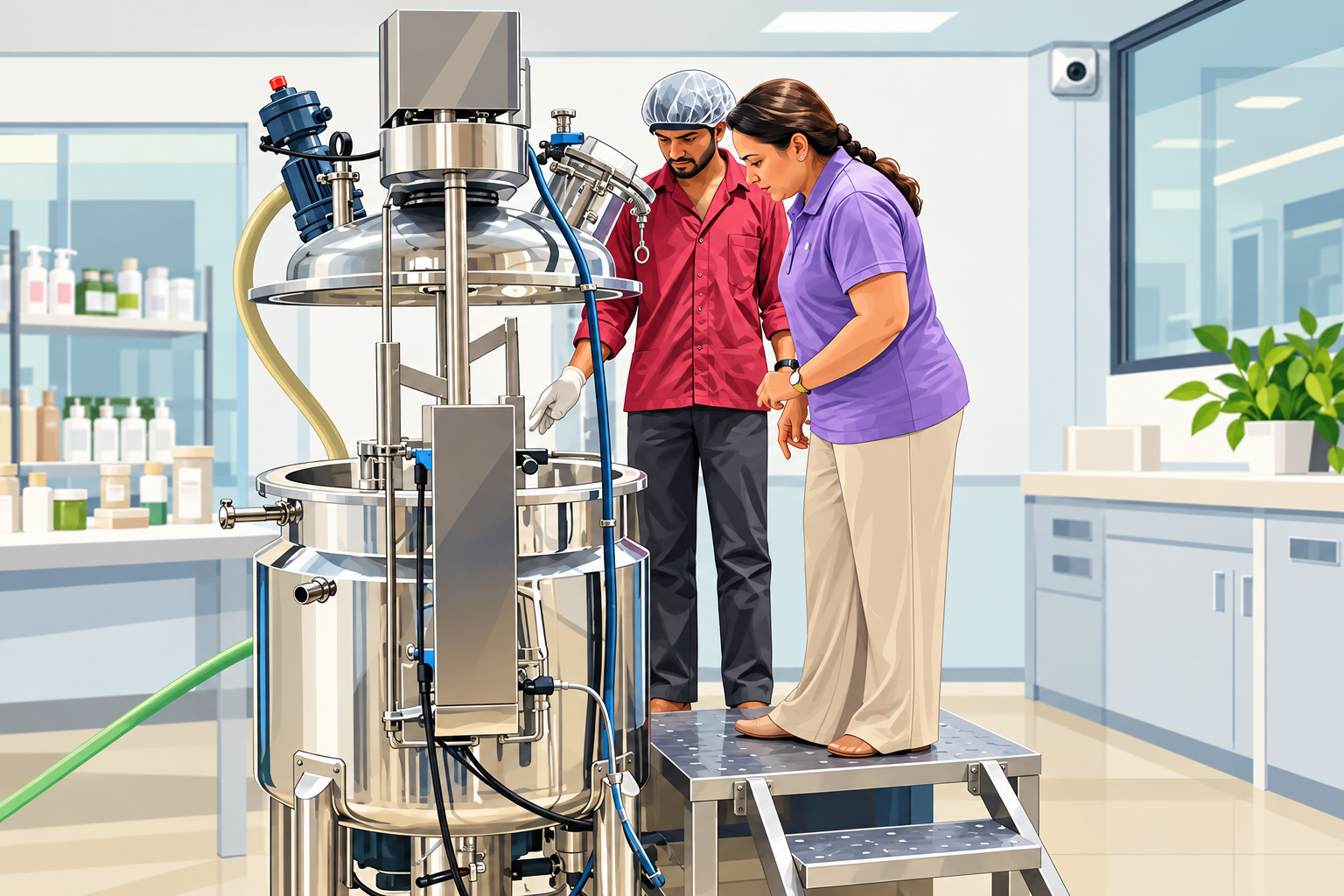
Dr Payal Joshi examines manufacturing equipment at a production facility. Drawing on her experience with Jishan Herbal since 2011, she stresses that cosmetic and wellness formulations should undergo stability evaluation, assessment in their intended packaging and successful commercial-scale reproduction before release. Photo: Courtesy/Dr Payal Joshi
Jishan Herbal founder stresses stability evaluation, final-packaging assessment and successful commercial scale-up before cosmetic and wellness formulations are cleared for release
Key Highlights
- Dr Payal Joshi says an initially approved sample should not automatically be considered a finished product.
- Cream viscosity, natural colour, fragrance and emulsion stability can change when formulations are tested over time.
- Formulations should be evaluated under defined stability conditions and in their intended final packaging.
- A successful laboratory sample must also be reproducible during commercial-scale manufacturing.
- Joshi says manufacturers must be prepared to delay a product when observations do not support its release.
Rajkot: A cosmetic or wellness formulation may appear satisfactory when its first sample is prepared, but that initial approval does not necessarily mean the product is ready for commercial production, according to Dr Payal Joshi, founder of Jishan Herbal.
Drawing on her experience since starting Jishan Herbal in 2011, Joshi says some of the most significant formulation problems can emerge only after an apparently successful sample is subjected to further evaluation.
On the first day, the texture may appear right, the colour may meet expectations and the fragrance may receive approval. But subsequent testing can reveal changes that were not visible during the initial assessment.
A cream may lose viscosity, a natural colour can begin to shift, a fragrance may change or an emulsion can show early signs of separation. A formulation that remains stable in bulk may also behave differently after being placed in its intended packaging or transferred from a laboratory batch to commercial-scale production.
“These are not textbook possibilities. They are part of real product development,” Joshi said.
Stability, Packaging and Scale-Up Matter
Joshi says this experience has shaped the way she approaches product development and the point at which a formulation should be considered ready.
“That is why I never consider the first approved sample to be the finished product,” she said.
According to Joshi, a formulation needs to be evaluated under defined stability conditions, tested in the packaging in which it is ultimately intended to be sold and successfully reproduced beyond the laboratory batch.
Commercial pressures can make that decision more difficult. Packaging may already have been printed and a proposed launch date may be approaching when testing identifies an issue requiring further work.
Joshi maintains that such circumstances should not determine whether a formulation is released.
“When the observations do not support release, the responsible answer is still: ‘Not yet,’” she said.
Her observations also carry a message for entrepreneurs and founders looking for manufacturers for cosmetic and wellness products.
While price and minimum order quantity, commonly referred to as MOQ, are important commercial considerations, Joshi says they should not be the only factors considered when choosing a manufacturing partner.
Founders should also ask whether their formulation will be evaluated in its final packaging, which stability parameters will be documented, how the laboratory sample will be transferred to commercial-scale manufacturing and what happens if the results indicate that the formulation requires revision.
The emphasis, she says, should be on identifying possible weaknesses before a product reaches the consumer rather than simply getting it into production as quickly as possible.
“A responsible manufacturer is not the one who says ‘yes’ the fastest. It is the one who identifies the product’s weaknesses before the customer does,” Joshi said.