Reg No. - CHHBIL/2010/41479ISSN - 2582-919X

Mahtari Vandan to Lakhpati Didi: How ₹1,000 a Month Is Helping Women Build Livelihoods in Chhattisgarh-By-Dhananjay Rathore
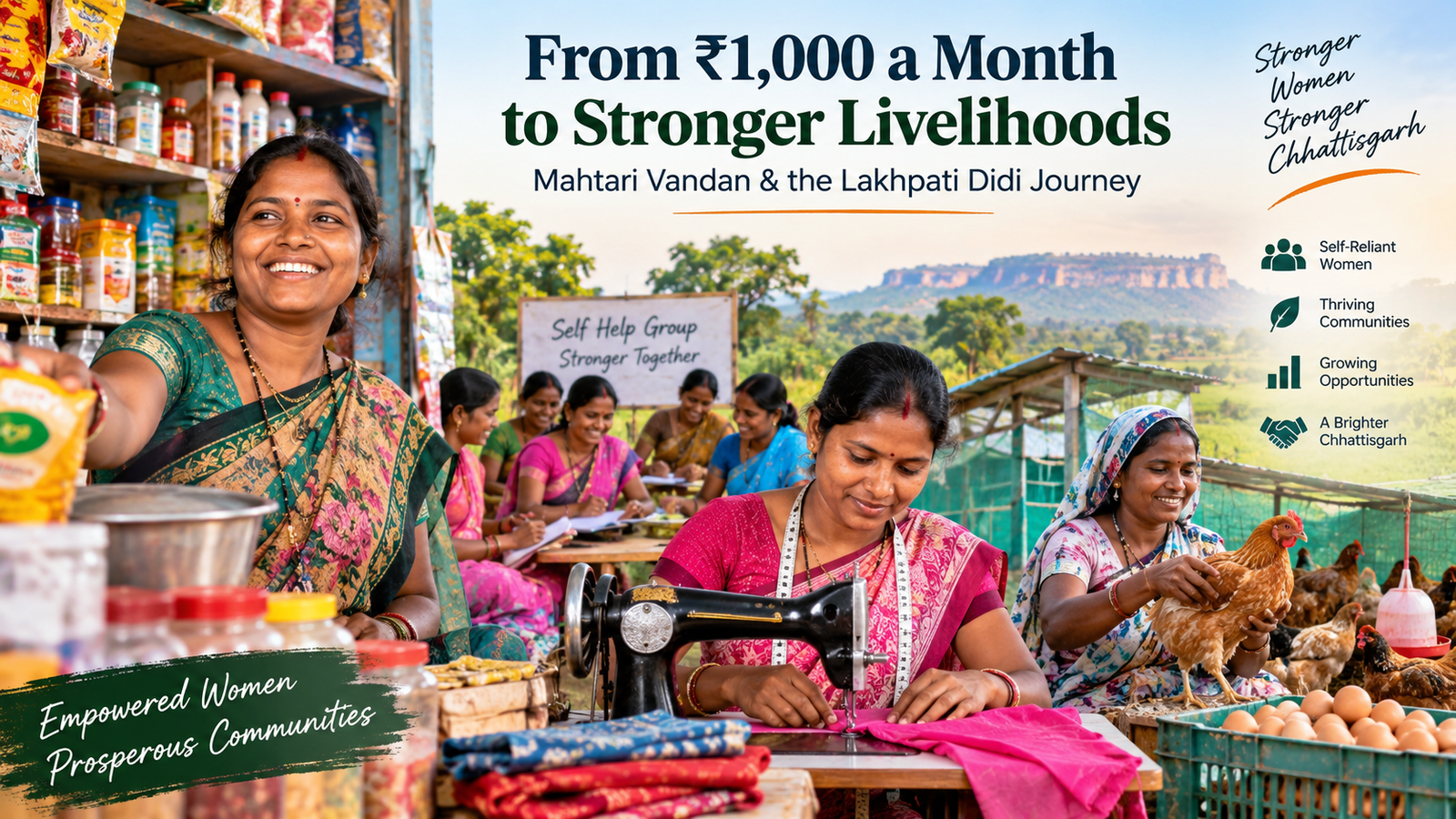
From assistance to enterprise: A representational visual depicts women engaged in grocery retail, tailoring, self-help group activities and poultry farming, reflecting the different livelihood activities through which women in Chhattisgarh are combining financial assistance, credit and entrepreneurship in their journey towards becoming Lakhpati Didis. Image: AI-generated/Representational
Regular financial assistance, self-help groups and access to credit are coming together to help women expand small businesses and create more sustainable sources of income
For millions of women in Chhattisgarh, the ₹1,000 received every month under the Mahtari Vandan Yojana is primarily a measure of financial support. But for some women already running small businesses or associated with self-help groups, that modest monthly amount is also becoming part of something larger — a journey towards greater economic independence.
The scheme currently covers around 68 lakh women beneficiaries, and ₹20,075.38 crore has been released through 31 instalments. The State Budget has provided ₹8,200 crore for the programme this year.
Those numbers establish the enormous scale of Mahtari Vandan. The more interesting story, however, lies in what can happen when regular financial assistance is combined with self-help groups, bank credit and livelihood opportunities.
Across Chhattisgarh, women are using these different forms of support to run grocery shops, undertake tailoring, raise poultry, operate hatcheries and develop other small enterprises. Some have already crossed an annual income of ₹1 lakh, while others are moving steadily in that direction.
When ₹1,000 Becomes More Than Household Assistance
A monthly payment of ₹1,000 cannot, by itself, transform a household into a successful business. But regularity has its own economic value.
For a woman running a small grocery shop, the amount can help replenish stock. For someone associated with a self-help group, it can complement savings or credit. For another household, it may meet a routine expense and leave other income available for investment in livelihood activities.
This is where Mahtari Vandan intersects with the wider network of women’s self-help groups and the state’s Mahtari Shakti Rin Yojana.
Since November 2024, around 41,124 beneficiaries have availed ₹102.38 crore in collateral-free self-employment loans under the complementary loan initiative.
Chief Minister Vishnu Deo Sai has linked this combination of financial support and access to credit with the larger objective of creating more Lakhpati Didis.
“The loans available under this scheme help women engaged in vegetable vending, handicrafts and other small occupations expand their businesses and strengthen the financial condition of their families. This is also helping realise Prime Minister Narendra Modi’s vision of ‘Lakhpati Didi’,” Sai said.
The experiences of individual beneficiaries illustrate how this process can work on the ground.
Ranu Kaivart: Not One Business, but Several
Ranu Kaivart of Andi village in Gaurela-Pendra-Marwahi district has chosen diversification.
She is engaged in tailoring, clothing and grocery businesses while also undertaking quail and indigenous poultry farming and hatchery activities. Together, these livelihood activities generate an annual income of around ₹3 lakh, according to the information provided by the state government.
Her experience is important because rural entrepreneurship does not always resemble a conventional single business. Several relatively small activities can collectively create a substantial household income.
It also reduces dependence on any one source of earnings.
Sita Maravi: Small Loans, Expanding Opportunities
For Sita Maravi of Gudumdewari, access to credit provided the opportunity to expand her livelihood activities.
She obtained a ₹25,000 bank loan for a grocery shop and another ₹50,000 through her self-help group for poultry farming. Her annual income has subsequently reached around ₹2.5 lakh.
The figures may appear modest when compared with large commercial enterprises, but at the household level such growth can make a significant difference.
It can mean greater financial security, more capacity to meet family expenses and, importantly, greater participation by women in decisions concerning household income.
Suman Lata Wakre: Beginning With ₹15,000
Suman Lata Wakre, also from Gudumdewari, started her grocery shop with just ₹15,000 obtained through a self-help group.
Once the business was established, she accessed a bank loan to expand it. Her annual income has now crossed ₹1 lakh.
Her journey demonstrates one of the most important functions of the self-help group model: relatively small amounts of capital can provide an entry point into enterprise for women who may otherwise find it difficult to access conventional business finance at the beginning.
The first loan does not necessarily create prosperity. It creates an opportunity to begin.
What follows depends upon the business, market conditions, financial discipline and the entrepreneur herself.
Keju Bai Salame: Turning the Monthly Payment Into Working Capital
Keju Bai Salame of Ramgarh in Mohla-Manpur-Ambagarh Chowki provides the most direct connection between Mahtari Vandan and micro-enterprise.
She uses the ₹1,000 received every month under the scheme to replenish stock in her grocery business.
More stock can mean more products available for customers and, consequently, an opportunity to increase sales. According to the account provided by the government, the strategy has helped her business grow and is taking her closer to becoming a Lakhpati Didi.
Her example also demonstrates why the economic impact of ₹1,000 cannot be measured merely by looking at the amount.
The same money can perform very different functions in different households. It may provide immediate consumption support in one family, savings in another and recurring working capital for a small enterprise in a third.
13.85 Lakh Women and the Lakhpati Didi Journey
Launched on March 10, 2024, in the virtual presence of Prime Minister Narendra Modi, the Mahtari Vandan Yojana has grown into one of Chhattisgarh’s largest women-focused financial assistance programmes.
The state government says 13.85 lakh women associated with self-help groups in Chhattisgarh have already entered the Lakhpati Didi category.
That figure also points towards a broader change in the way women’s welfare can be viewed.
Financial assistance and economic empowerment are related, but they are not identical.
A welfare payment provides immediate financial support. Sustainable economic empowerment requires something more: skills, access to credit, viable markets, opportunities to earn, control over financial decisions and the ability to sustain an enterprise over time.
The emerging model in Chhattisgarh attempts to connect these different elements.
Mahtari Vandan provides regular financial assistance. Self-help groups create networks of savings, credit and collective support. Bank loans provide opportunities for expansion. Livelihood programmes offer pathways towards income generation.
When these elements work together, the ₹1,000 monthly payment can become one part of a much larger economic process.
Exposure Beyond the Village
The state government has also made budgetary provision for the Lakhpati Didi Bhraman Yojana, under which Lakhpati Didis will be provided opportunities to visit commercial and economic centres across the country as well as prominent Shakti Peethas.
Exposure visits may appear less significant than direct financial assistance, but successful entrepreneurship also depends upon ideas.
Seeing how businesses operate elsewhere, understanding products and markets and interacting with other entrepreneurs can broaden the possibilities women imagine for their own enterprises.
For a woman whose business began with a small grocery shop, tailoring machine or poultry unit, such exposure can provide a view of what the next stage might look like.
The Real Measure Will Be Sustainability
The stories of Ranu Kaivart, Sita Maravi, Suman Lata Wakre and Keju Bai Salame provide encouraging examples, but they also underline an important distinction.
Becoming a Lakhpati Didi should not merely be about crossing an income figure once. The larger objective must be to create livelihoods that remain viable year after year.
That requires access to markets, affordable credit, financial literacy, skills, infrastructure and continued opportunities for enterprise.
For this reason, the longer-term significance of Mahtari Vandan may eventually be judged not only by the 68 lakh women receiving ₹1,000 every month or the thousands of crores transferred into their accounts.
An equally important measure will be how many women are able to use the financial space created by such assistance — together with SHGs, loans and livelihood opportunities — to establish income streams over which they have greater control.
The four women featured here represent different routes towards that objective. One diversified across several businesses. Another combined bank and SHG loans. A third began with ₹15,000 and expanded. The fourth is putting her monthly ₹1,000 directly back into her shop.
Different journeys, different amounts and different businesses — but a common aspiration: moving from receiving financial assistance towards building financial agency and sustainable livelihoods.
About the Author: Dhananjay Rathore is Joint Director, Chhattisgarh Public Relations, and writes on governance, public administration and development initiatives in Chhattisgarh.