Reg No. - CHHBIL/2010/41479ISSN - 2582-919X

Silent Diplomacy: Did India Help Pave the Way for Russia-Ukraine Peace Talks?
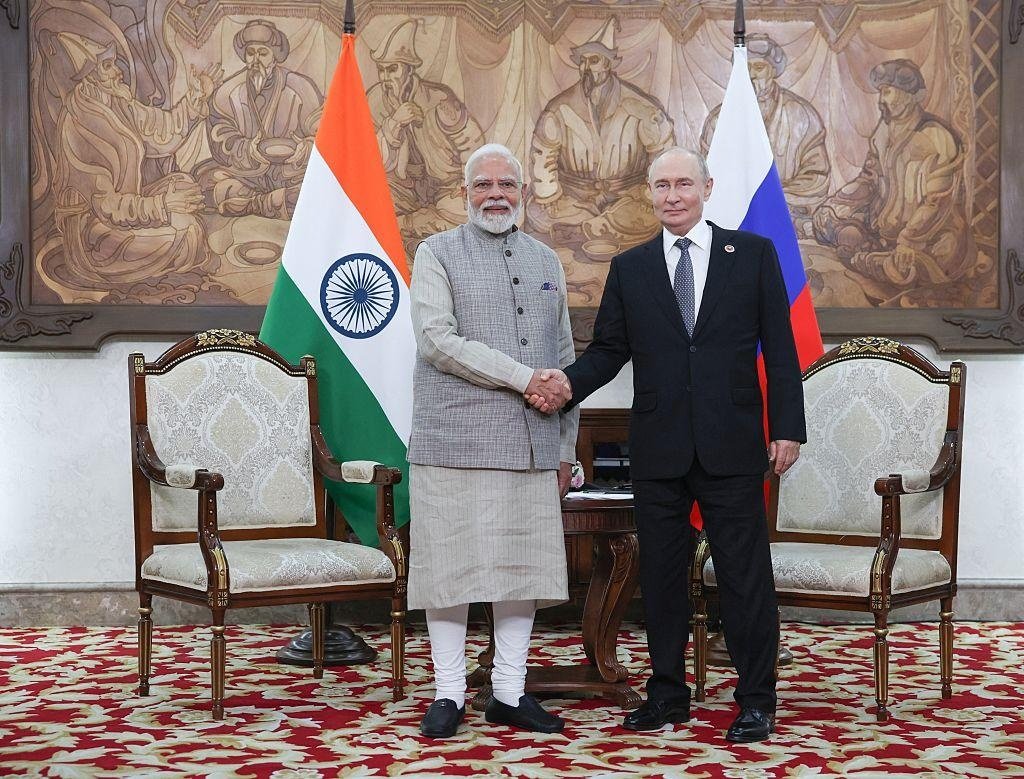
Diplomacy Behind the Handshake? Prime Minister Narendra Modi with Russian President Vladimir Putin during their meeting on the sidelines of the SCO Summit in Bishkek on August 31, 2026. Modi’s call to move from “endless war” towards an “end of war”, followed by External Affairs Minister S. Jaishankar’s diplomatic engagements in Kyiv and Warsaw and a renewed US peace initiative, has raised an intriguing question: has India been quietly helping to build a bridge between Moscow, Kyiv and Washington?( File Photo)
From Modi’s message to Putin in Bishkek to Jaishankar’s engagements with Moscow and Kyiv, the diplomatic sequence points to an increasingly active Indian role — but whether New Delhi actually brokered the latest peace initiative remains unconfirmed
New Delhi: In diplomacy, what is not announced can sometimes be as important as what is. Over the past several weeks, India has been talking to virtually every important player capable of influencing the Russia-Ukraine conflict. Individually, each engagement can be explained as routine diplomacy. Taken together, however, they form a sequence difficult to ignore.
The question therefore deserves to be asked: Did India quietly help create the diplomatic space for the latest attempt to bring Russia and Ukraine back towards negotiations?
There is no official confirmation from New Delhi that India acted as a mediator. Nor is there sufficient public evidence to claim that the latest American initiative was brokered by India. Any such conclusion would go beyond what is presently known.
But there is a difference between claiming mediation and recognising diplomatic signalling. And the signals are significant.
India has maintained communication with Moscow while simultaneously engaging Kyiv and Washington. Prime Minister Narendra Modi’s meeting with Russian President Vladimir Putin at the SCO Summit in Bishkek was particularly significant. There, Modi publicly returned to an argument that has increasingly defined India’s position on the conflict.
“We need to move from the state of endless war to the end of war.”
Modi’s message was not simply a rhetorical appeal for peace. He emphasised that every additional day of conflict pushes humanity backwards and reiterated India’s willingness to support efforts aimed at achieving a peaceful settlement. His remarks to Putin on August 31 are independently documented.
Putin’s response was restrained, but the diplomatic conversation did not end in Bishkek.
External Affairs Minister S. Jaishankar subsequently travelled to Kyiv, where India again offered its assistance to efforts aimed at ending the conflict. His September 3 visit came only days after Modi’s conversation with Putin, reinforcing India’s attempt to remain engaged with both sides rather than becoming identified exclusively with either Moscow or Kyiv.
That is precisely where India’s diplomatic position becomes interesting.
New Delhi enjoys a longstanding strategic relationship with Moscow but has also consistently maintained that dialogue and diplomacy offer the only sustainable route out of the Ukraine conflict. Unlike many countries attempting to influence the negotiations, India can communicate with Russia without the political baggage carried by Western powers while simultaneously maintaining relations with Ukraine, Europe and the United States.
Then came another development.
US envoys Steve Witkoff and Jared Kushner travelled to Moscow for talks with Putin before proceeding to Kyiv for discussions with Ukrainian President Volodymyr Zelenskyy. The Moscow discussions lasted more than three hours and were described by the Russian side as substantive and constructive, although no breakthrough was announced.
The Kremlin has since said it does not rule out a resumption of trilateral negotiations involving Russia, Ukraine and the United States, although it considers discussion of dates or venues premature.
None of this proves an Indian mediation channel.
But diplomacy rarely moves in a perfectly visible straight line. Governments exchange assessments, test proposals, convey red lines and explore possibilities through conversations that may never appear in official statements. A country does not necessarily have to sit at the negotiating table to influence what eventually reaches that table.
India may therefore be playing a role better described as facilitation rather than mediation — keeping channels open, carrying perspectives and encouraging the principal actors to explore political space for negotiation.
That distinction is important.
Calling India the broker of Russia-Ukraine peace talks would presently be premature. Saying that India appears to be using its unusual access to Moscow, Kyiv and Washington to encourage diplomacy is much more defensible.
There is another reason for caution. Peace remains distant. Russia and Ukraine continue to disagree fundamentally over territory, security guarantees and the conditions for ending hostilities. Indeed, Russian missile attacks on Kyiv resumed shortly after the latest American diplomatic mission, demonstrating how quickly battlefield realities can overwhelm diplomatic optimism.
Yet diplomacy is rarely measured only by immediate breakthroughs.
Sometimes its first achievement is simply getting adversaries to consider talking again.
If India’s conversations over recent weeks contributed even indirectly to that possibility, New Delhi may have achieved something significant without issuing a declaration, claiming credit or placing itself at the centre of the story.
That would also be characteristic of the diplomatic approach India appears to favour: maintain relationships, speak to competing sides and allow the process rather than publicity to become the objective.
The coming weeks may reveal whether the sequence was coincidence or coordination. Until then, India should neither be prematurely crowned as the mediator nor excluded from the diplomatic equation.
Perhaps the most revealing clue remains Modi’s choice of words in Bishkek:
“We need to move from the state of endless war to the end of war.”
The world now waits to see whether those words were merely an appeal — or part of a much quieter diplomatic effort already under way.

YOU MAY LIKE THIS