Reg No. - CHHBIL/2010/41479ISSN - 2582-919X

India, China Open Door to Better Understanding of LAC Perceptions After Doval-Wang Talks
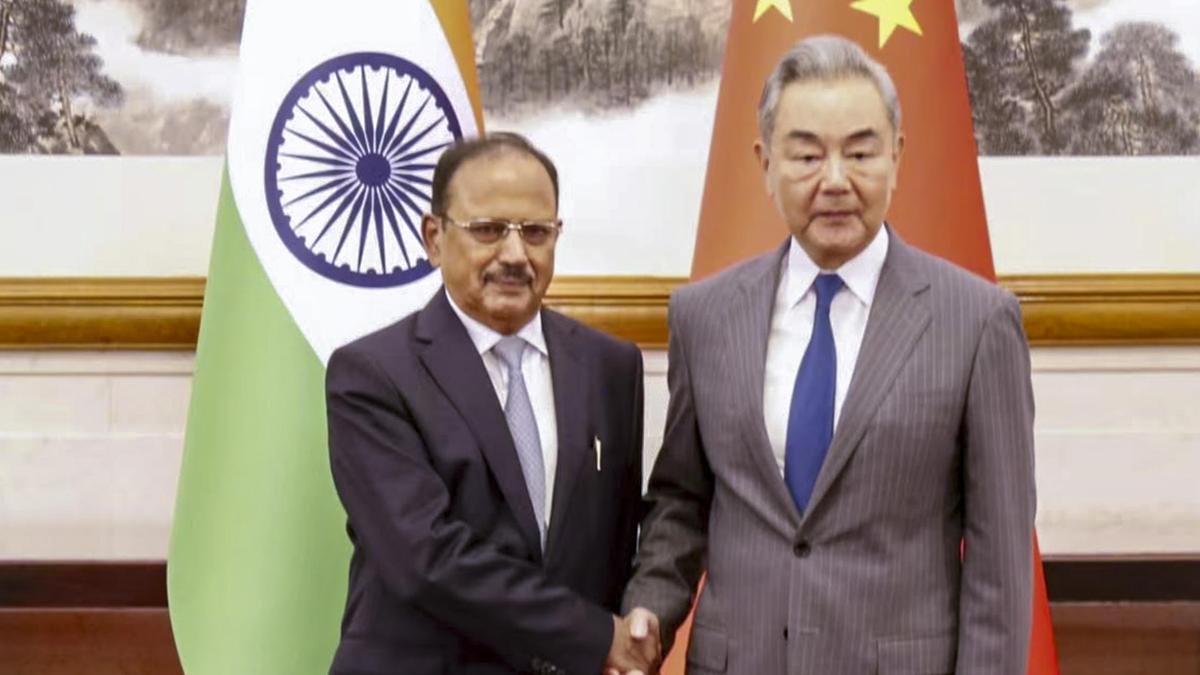
National Security Adviser Ajit Doval with Chinese Foreign Minister Wang Yi during an India-China engagement. The latest Special Representatives’ talks in Beijing have opened the possibility of improving mutual understanding of LAC perceptions in appropriate areas as part of efforts towards better border management. Photo Credit: PTI
Eight-point consensus signals movement on border management, with both sides agreeing to improve understanding of the LAC in appropriate areas and advance boundary delimitation discussions
Key Highlights
- India and China discuss improving understanding of their respective LAC perceptions in “appropriate areas”
- Existing diplomatic and military mechanisms to address ground situations and prevent miscalculation
- Expert Group to advance discussions on an “Early and Substantial Harvest” of boundary delimitation
- Development revives an issue that has remained largely stalled since map exchanges in the Middle Sector
- The formulation stops short of formally restarting the earlier LAC clarification process
Beijing: India and China have opened a potentially significant new avenue for managing their long-running boundary dispute, agreeing to explore ways of improving their understanding of each other’s perceptions of the Line of Actual Control (LAC) in appropriate areas.
The development emerged from the 25th Round of Special Representatives’ talks on the India-China boundary question, held in Beijing on Tuesday between National Security Adviser Ajit Doval and Chinese Foreign Minister Wang Yi.
An eight-point consensus issued following the talks said the two sides “discussed ways to improve understanding of LAC in appropriate areas, for better border management.”
The carefully worded formulation is significant because differing perceptions of where the LAC runs have repeatedly contributed to face-offs between Indian and Chinese troops, particularly in the Western Sector.
The two sides also agreed that situations arising on the ground should be addressed promptly through established diplomatic and military channels, including the Working Mechanism for Consultation and Coordination (WMCC), local commander-level meetings and other agreed mechanisms.
The objective, according to the consensus, is to resolve outstanding issues while reducing the risk of “misunderstanding and miscalculation along the LAC.”
A cautious return to an old but unresolved question
The latest agreement does not amount to a formal revival of the LAC clarification exercise attempted decades ago. But the willingness to improve understanding of competing perceptions could prove important if it develops into practical arrangements on the ground.
India has long argued that greater clarity about the LAC could reduce encounters between patrols operating in areas where territorial perceptions overlap.
Under the 1996 confidence-building agreement, India and China had agreed to work towards a common understanding of the LAC alignment. Maps reflecting the two sides’ respective perceptions were subsequently exchanged for the Middle Sector, but the exercise failed to progress in the Western Sector, where differences were considerably sharper.
Prime Minister Narendra Modi again raised the need for LAC clarification during his 2015 visit to China. Beijing, however, remained cautious about the proposal, arguing that such an exercise could complicate negotiations over the broader boundary question.
The prolonged military confrontation in eastern Ladakh beginning in 2020 fundamentally altered the context. The crisis demonstrated how differing territorial perceptions, combined with close military deployments, could rapidly escalate into a much wider breakdown in border stability.
The latest consensus therefore appears to concentrate on practical understanding and border management rather than formally resurrecting the politically sensitive “clarification” process.
Another important outcome is the decision that an Expert Group on Boundary Delimitation will advance discussions on an “Early and Substantial Harvest” of boundary delimitation. The process is expected to begin after the two sides agree on its terms of reference and could initially concentrate on areas where differences over alignment are relatively limited.
The political endorsement from Doval and Wang gives the process additional weight. Yet its real significance will depend on whether the language agreed in Beijing translates into workable arrangements between military commanders and diplomats along contested stretches of the frontier.
For India and China, the challenge remains larger than preventing individual patrol confrontations. Restoring durable stability requires mechanisms capable of ensuring that differing perceptions of the LAC do not again develop into a military crisis.

YOU MAY LIKE THIS