Reg No. - CHHBIL/2010/41479ISSN - 2582-919X

Jharkhand Government Calls Agitating Students for Fresh Talks as Recruitment Row Enters Crucial Phase
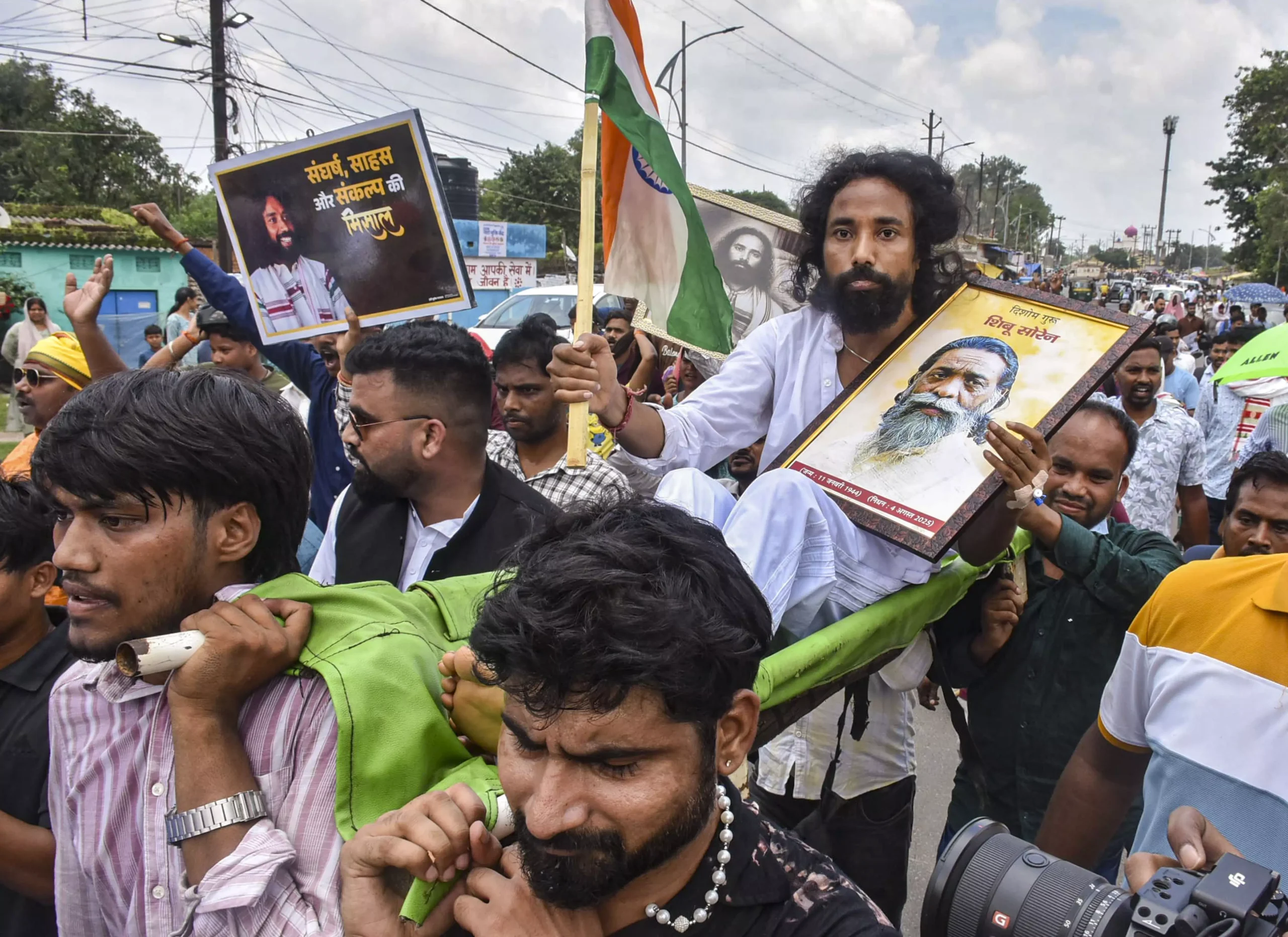
Student leader Devendra Nath Mahto holds the Tricolour and a portrait of late educationist Shibu Mahto as he is carried by supporters during a protest march in Ranchi over alleged irregularities in JPSC, JSSC-CGL and other recruitment examinations. The agitation has entered its fourth week, with protesters demanding a CBI probe into alleged paper leaks and cancellation of the JSSC-CGL examination-Photo: PTI
Protesters agree to seventh round of dialogue but remain firm on CBI probe into alleged recruitment irregularities and cancellation of JSSC-CGL examination
In Short
- Jharkhand government invites agitating students for fresh talks in Ranchi on August 17
- Students agree to participate in dialogue along with their legal adviser
- JPSC-JSSC Reforms Manch remains firm on demand for CBI investigation
- Protesters seek cancellation of JSSC-CGL examination over alleged irregularities
- Six previous rounds of government-student talks fail to produce a breakthrough
- Latest dialogue comes after more than three weeks of sustained student protests
- Students say they favour a negotiated solution but will not abandon their core demands
Ranchi: The Jharkhand government has invited students protesting alleged irregularities in state recruitment examinations for a fresh round of talks on Monday, August 17, opening another possibility of resolving an agitation that has continued for more than three weeks.
The proposed meeting assumes significance as six previous rounds of dialogue between representatives of the government and the protesting students failed to produce a breakthrough.
The students have accepted the latest invitation but made it clear that participation in the talks should not be interpreted as a dilution of their demands.
At the centre of the agitation are allegations concerning recruitment examinations conducted by the Jharkhand Public Service Commission (JPSC) and the Jharkhand Staff Selection Commission (JSSC). The protesters have been demanding greater transparency and accountability in the recruitment process, with their principal demands including a Central Bureau of Investigation (CBI) probe into alleged irregularities and cancellation of the JSSC Combined Graduate Level examination.
The latest initiative for dialogue followed a meeting between administrative officials and protesting students at Jaipal Singh Munda Stadium in Ranchi, which has emerged as a major centre of the agitation.
The Sub-Divisional Officer and the Additional District Magistrate, Law and Order, met representatives of the protesters at the site, following which the government offered another round of discussions.
The talks are scheduled for 2 pm at the State Guest House in Ranchi, and the students have also been allowed to take their legal adviser to the meeting.
The presence of a legal adviser could make the seventh round of negotiations substantially different from earlier discussions, particularly as the protesters are seeking action on matters involving the legality and credibility of recruitment examinations.
JPSC-JSSC Reforms Manch, which has been spearheading the agitation, confirmed that it had accepted the government’s proposal.
Its leader Ravindra Paswan said the students were willing to participate because they wanted the dispute resolved through dialogue rather than prolonged confrontation.
“We will definitely go for the talks as we want to resolve the issue through dialogue. But we are firm on our two demands — a CBI probe into irregularities in recruitment tests and cancellation of the JSSC-CGL examination,” Paswan said.
The students are expected to decide the composition of their delegation before the meeting.
Seventh Round Puts Dialogue to the Test
The fresh negotiations come after six rounds of discussions failed to bridge the differences between the government and the protesters.
The previous round, held on August 9, ended without a breakthrough, leaving the agitation to continue.
That history makes Monday’s meeting particularly important.
For the students, the issue has moved beyond individual examination results. Their agitation now centres on their confidence in the recruitment system itself.
Government employment carries enormous importance for young aspirants who often spend years preparing for competitive examinations. Many invest substantial family resources in coaching, accommodation, study material and repeated attempts to secure a limited number of posts.
Consequently, allegations of paper leaks or irregularities can have an impact extending far beyond a particular examination.
For candidates, the question becomes one of whether the system in which they have invested years of preparation can guarantee a fair contest.
The protesters have therefore sought a CBI investigation, arguing that an independent probe is necessary to establish the facts surrounding the alleged irregularities.
Their second major demand — cancellation of the JSSC-CGL examination — is potentially more complicated because cancellation affects not only protesters questioning the examination but also candidates who participated in it and may consider their results legitimate.
This places the government in a difficult position.
Any decision must address serious concerns over examination integrity while also taking into account candidates whose interests could be affected by cancellation and a fresh recruitment exercise.
The demand for a CBI investigation similarly requires the government to decide whether the allegations warrant transferring the matter to a central investigating agency or whether existing mechanisms are sufficient.
These are likely to be among the central issues during the fresh discussions.
The agitation has also acquired a broader political dimension.
During demonstrations over alleged irregularities in the 14th JPSC examination, JSSC-CGL and other recruitment tests, protesters have raised demands ranging from an independent investigation into alleged paper leaks to political accountability.
Student leader Devendra Nath Mahto has been among the prominent faces visible during the agitation. Protesters have also attempted marches as part of their campaign, increasing pressure on the administration to find a negotiated resolution.
As the protests continued, the confrontation increasingly became a test not merely of recruitment administration but of the government’s ability to engage with young aspirants whose concerns directly involve their careers.
The decision to reopen dialogue is therefore significant.
It indicates that both sides continue to see negotiations as a possible route out of the impasse despite the failure of previous meetings.
For the government, the challenge will be to present proposals capable of restoring confidence without prejudging allegations that require investigation.
For the students, the challenge will be to translate a broad agitation into demands that can be addressed through administrative, investigative or legal processes.
The involvement of their legal adviser could help in that process.
It may allow the discussion to move beyond slogans and political exchanges towards specific questions: what evidence exists, which allegations require investigation, what legal mechanism is available and what remedy can be provided if irregularities are established.
The government will also have to recognise the larger message emerging from the agitation.
Recruitment examinations are not merely administrative exercises. For thousands of young people, they represent years of preparation and often their principal route towards economic security.
Transparency in conducting examinations, therefore, is inseparable from public confidence in government recruitment.
At the same time, allegations must be established through credible investigation rather than treated as proven merely because they have become the subject of protest.
That distinction is important both for the integrity of the recruitment process and for candidates whose futures depend on it.
With the agitation extending beyond three weeks and six rounds of talks already behind the two sides, expectations from the latest meeting are inevitably higher.
A seventh meeting that ends without movement could deepen frustration among the protesters. A meaningful agreement on investigation, examination-related concerns or a transparent mechanism for reviewing the allegations, on the other hand, could provide the first significant opening for ending the standoff.
The students have already indicated that they are prepared to sit across the table.
Their message, however, is equally clear: dialogue alone will not be regarded as a solution unless it produces tangible action on the issues they have raised.
Monday’s meeting will therefore test whether the government and the protesting students can move from repeated rounds of discussion towards an outcome capable of restoring confidence in Jharkhand’s recruitment process.

YOU MAY LIKE THIS