Reg No. - CHHBIL/2010/41479ISSN - 2582-919X

PM Must Demand Accountability from the Education Minister-By-Kumar Bahukhandi (Editorial)
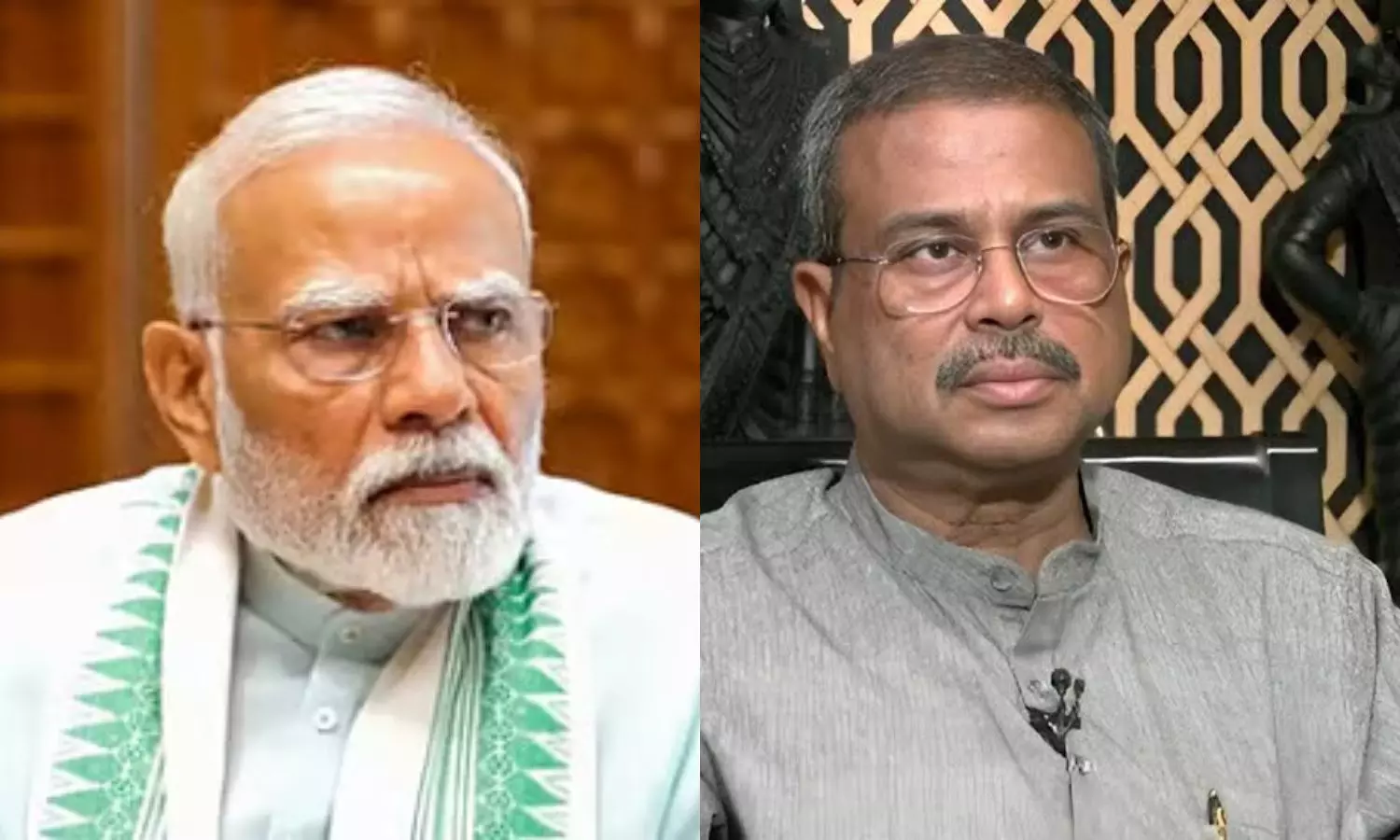
Prime Minister Narendra Modi and Union Education Minister Dharmendra Pradhan amid intensifying demands for accountability over examination irregularities and failures affecting students across the country-Photo Credit- Social Media ( File Photo)
An admission of failure is not enough when repeated examination lapses have shaken the confidence of millions of students.
Prime Minister Narendra Modi’s decision to acknowledge the seriousness of the examination crisis is an important, though considerably delayed, intervention. His assurance of fast-track trials and stringent punishment for those involved in paper leaks recognises that the damage extends far beyond one cancelled examination. It concerns the credibility of India’s entire educational system and the future of millions of young people.
But acknowledgement without accountability cannot restore confidence.
The NEET controversy has caused months of anxiety, financial loss and emotional distress to students and their families. Candidates spend years preparing for such examinations. Many families exhaust their savings on coaching, travel and application expenses. When an examination is compromised, it is not merely an administrative mistake—it is an assault on merit and equal opportunity.
Students protesting in Delhi and other cities are therefore not demanding a political favour. They are asking the government to accept responsibility for repeated failures in conducting examinations. Their principal demand remains the resignation of Union Education Minister Dharmendra Pradhan. The protests have continued despite police restrictions, detentions and reports of force being used against demonstrators.
The Prime Minister has correctly treated examination integrity as a national issue. However, describing it as a national problem should not become a means of separating it from ministerial responsibility. Public institutions function under ministers, and ministers must answer when those institutions repeatedly fail.
The question is not whether the Education Minister personally leaked an examination paper. The principle of ministerial accountability is broader: when a department under a minister’s supervision repeatedly produces chaos, insecurity and loss of public confidence, responsibility cannot be placed entirely on unidentified officials or outside conspirators.
The crisis is not limited to competitive examinations.
My own family recently experienced the frustration caused by an unreliable education-related digital system. My son believed that his examination paper deserved better marks and wanted to apply for revaluation, but he was unable to access the CBSE website properly. For a student waiting anxiously to exercise a legitimate academic right, a malfunctioning portal is not a small technical inconvenience. It can determine whether an error is reviewed before a deadline expires.
The contrast becomes striking when we consider the example of young cybersecurity researcher Nisarga Adhikary. He responsibly identified and reported serious security weaknesses in a CBSE online marks-submission system. His expertise was subsequently recognised by IIT Kanpur.
My son innocently asks: “Why doesn’t Modi uncle make someone like Nisarga the Education Minister, so that students do not have to face such problems again?”
A teenager’s question may sound simple, but it contains a powerful message. Young India does not merely want speeches, promises and committees. It wants capable people who understand technology, protect examination systems and respond before failures become national scandals.
Of course, technical expertise alone does not qualify someone to run a ministry. Yet the government can certainly bring talented young researchers into institutional decision-making, cybersecurity audits and examination-technology reforms. The education system should not wait for students to expose weaknesses that highly paid agencies and officials ought to have detected themselves.
If the Prime Minister truly believes that those who damage the future of the youth must not be spared, the principle must apply at every level. Punishing brokers and lower-level officials is necessary, but it is not sufficient. Political leadership must also demonstrate that responsibility rises to the top.
Dharmendra Pradhan’s resignation would not solve every weakness in India’s examination system. It would, however, send a clear message that high office carries consequences and that students’ futures cannot be treated as collateral damage in an administrative failure.
India’s youth are not asking the government for sympathy. They are asking for trustworthy examinations, accessible digital services and a system in which hard work is not defeated by corruption or incompetence.
The Prime Minister has acknowledged the seriousness of the wrong. He must now complete that acknowledgement with meaningful accountability.

YOU MAY LIKE THIS