Reg No. - CHHBIL/2010/41479ISSN - 2582-919X

The Modi Era: From the Resolve for a Developed India to the Renaissance of ‘Devbhoomi’-By- Pushkar Singh Dhami
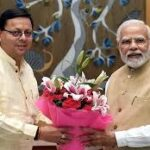
CM Dhami stated that PM Modi’s 12-year tenure is a saga of the resurgence of India’s self-confidence. (Photo- Instagram )
The 12 years under the leadership of Prime Minister Narendra Modi represent not merely a political tenure but a saga of the resurgence of India’s self-confidence. It is a story of kindling the lamp of hope in the lives of crores of poor people who, for the first time, felt that the government could reach their very doorsteps.
Dehraqdun(Uttarakhand): People of my generation, myself included, grew up dreaming of a strong, capable, and self-respecting India—an India advancing rapidly on the path of development, whose voice commands the world’s attention, and, above all, an India whose leadership enjoys the immense trust of its great people. Yet, for the better part of our lives, we had to compromise on this dream. However, we are fortunate to witness this dream becoming a reality before our very eyes. This has been made possible through the tireless efforts, bold leadership, and a life dedicated to Antyodaya (upliftment of the last person) by Prime Minister Narendra Modi. Today, India is strong, capable, and self-respecting.
Statistics themselves narrate this success story of India under Modi-ji’s leadership. Four crore permanent houses built under the PM Awas Yojana, free monthly rations for 81 crore people, free medical treatment for 60 crore people under Ayushman Bharat, and collateral-free Mudra loans worth ₹40 lakh crore—only a visionary dedicated to Antyodaya could achieve all this. Consider this: in the seven decades following independence, piped drinking water reached a total of only 3.2 crore households; today, that figure has more than quadrupled to reach 16 crore. Until 2014, only five cities in the country were connected by metro trains; now, that number has risen to 26. The metro rail network has also expanded from 248 kilometers to 1,155 kilometers.
Today, India is providing leadership to the world across every sector. India alone accounts for 56 percent of the world’s total digital transactions. India, which once relied on foreign nations for its defense needs, is today scaling new heights in defense production and exports. From space exploration to artificial intelligence, and from startups to semiconductor manufacturing, India is scripting new chapters of self-reliance. Fulfilling his pledge to honor and empower women, Prime Minister Narendra Modi has granted Permanent Commission to women in the armed forces; it was this very ‘Nari Shakti’ (women’s power) that proved formidable against the enemy during ‘Operation Sindoor’. While the country was once plagued by both externally sponsored terrorism and the Naxal menace brewing within, today it not only decisively controls Naxal violence but also possesses the courage to strike at terror infrastructure across the border. This is a new India—one that seeks peace yet knows how to ensure its own security.
The impact of the national vision of a ‘Viksit Bharat’ (Developed India)—taking shape under the leadership of Prime Minister Modi—is visible in every state of the country. Uttarakhand stands as a powerful example of this. For us, the residents of ‘Devbhoomi’ (the Land of Gods), Prime Minister Narendra Modi’s tenure has proven to be truly historic—worthy of being recorded in golden letters.
The Prime Minister’s reverence and deep personal bond with Uttarakhand are no secret. It is for this reason that, with the support of the Central Government, development projects worth over ₹2 lakh crore are currently underway in the state. Over the past four years, unprecedented progress has been achieved in sectors such as road, rail, and air connectivity, tourism, healthcare, religious rejuvenation, and industrial development.
The Char Dham All-Weather Road project, being constructed at a cost of ₹11,700 crore, is progressing rapidly. The Delhi-Dehradun Expressway, built at a cost of ₹13,000 crore, has significantly reduced both travel time and distance; the journey between Delhi and Dehradun can now be completed in two and a half hours. Additionally, work is underway on other key projects such as the Sitarganj-Tanakpur, Paonta Sahib-Dehradun, Bhaniyawala-Rishikesh, Kathgodam-Lalkuan-Haldwani bypass, and Rudrapur bypass routes.
Rail connectivity in the state’s remote mountainous regions was once merely a dream. Today, the Rishikesh-Karnaprayag rail project is advancing rapidly towards completion. The Central Government has also approved the ₹48,000 crore Tanakpur-Bageshwar railway line project. Eleven railway stations in the state are being modernized under the Amrit Bharat Station Scheme.
Significant achievements have also been made in the realm of air connectivity. The Jolly Grant, Pantnagar, and Pithoragarh airports have been expanded. Eighteen heliports are being developed in the state under the UDAN scheme, with services already operational at twelve of them. Several areas—including Gauchar, Srinagar, Chinyalisaur, Haldwani, Munsiyari, Pithoragarh, Pantnagar, Champawat, Bageshwar, Nainital, and Almora—have been connected via air services. While there were only two heliports in the state in 2022, that number has now risen to seven. The number of helipads has nearly doubled, reaching 118.

YOU MAY LIKE THIS