Reg No. - CHHBIL/2010/41479ISSN - 2582-919X

How the BJP won West Bengal
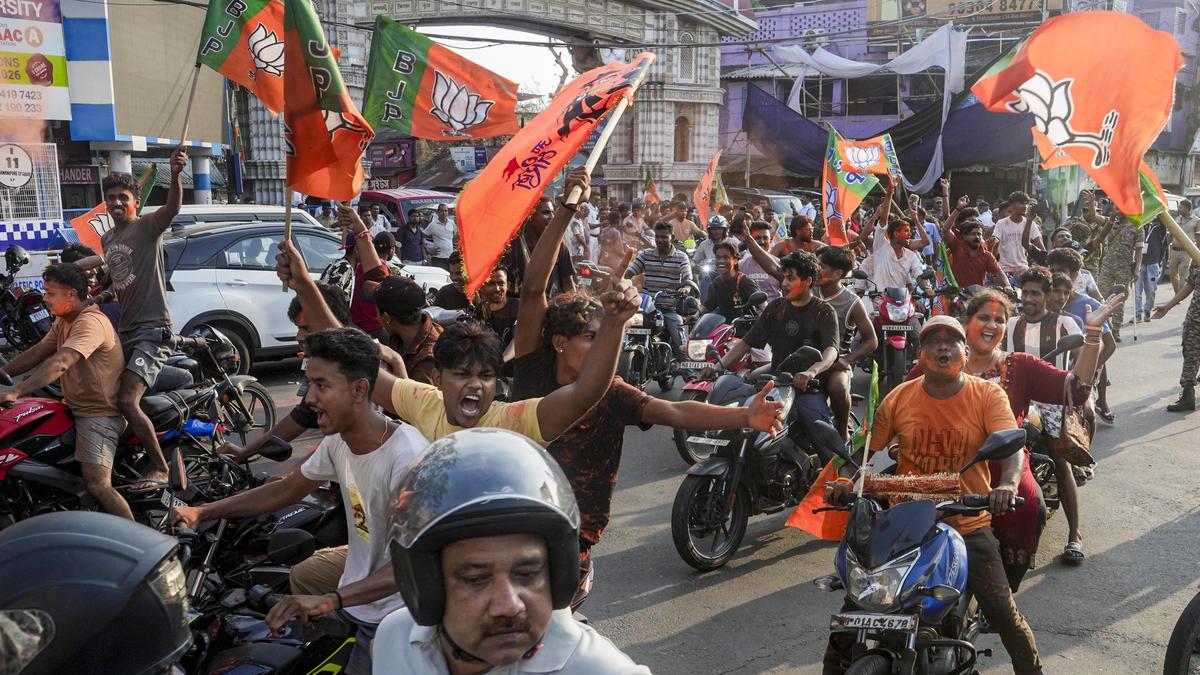
BJP supporters celebrate party’s lead near the residence of West Bengal Chief Minister Mamata Banerjee on the day of Assembly election results, in Kolkata, Monday, May 4, 2026. – Photo Credit: primelookindia.com
Prime Minister’s 19 rallies, Home Minister’s ubiquitous presence reassured BJP voters they would not be abandoned as in 2021; mending of fractures in the State unit, Central Ministers’ support pay off in big win
The BJP’s first solo victory in West Bengal was not the smooth progression of one win after another, but it has been decades in the making. From tapping Mamata Banerjee’s newly launched party Trinamool Congress as an NDA ally at the Centre during the Vajpayee era to being the only party with the firepower to halt Mamta Banerjee’s bid for a fourth term in the State, it has been a long slog.
The peaks of the BJP’s tally of 18 seats in the 2019 Lok Sabha election were followed by the troughs of a loss in the 2021 Assembly polls and a depleted tally of parliamentary seats in 2024. Therefore, for the 2026 Assembly polls, the organisational planning and messaging had to sit just right.
Prime Minister Narendra Modi held 19 big rallies across the State, and two well attended road shows in Howrah and Kolkata, in the crucial Greater Kolkata zone that traditionally did not vote for the BJP.
The ubiquitous Amit Shah
Union Home Minister Amit Shah led the intricate organisational work of the BJP, camping in the State for 15 days, with overnight stays in five different zones during this time, sorting out organisational hiccups through meetings with workers at the ground level. He addressed over 30 public meetings, undertook 12 roadshows, and umpteen meetings to bring the message home.
The post-poll violence against BJP supporters following the 2021 Assembly election had left a big hole in terms of trust in the BJP’s campaign. However, Shah’s ubiquitous presence made a difference when it came to reassuring BJP voters that this time they would not be left to their own devices. BJP leaders felt that the abandonment of the party’s campaign midway through the 2021 polls because of the second wave of the COVID-19 pandemic had cost it dearly, reinforcing Shah’s decision, in 2026, to see the campaign through to the end.
Effective outreach
Union Ministers Bhupendra Yadav and Dharmendra Pradhan, Lok Sabha MP Biplab Deb, and Sunil Bansal, the national general secretary in charge of West Bengal, also pitched in significantly.
While Yadav and Bansal dealt with the BJP’s organisational issues, deployment of workers, and sorting out problems on the ground, Pradhan, who had handled Nandigram in the 2021 election, met with leaders of different communities for comprehensive outreach. Deb, the former Chief Minister of Tripura, who had supplanted the Communist government in that State in 2018, did micro outreach in previous Left bastions within Kolkata.
Unity pays off
The party’s State president Samik Bhattacharya, a lifelong BJP member, managed to broker peace in a party that had, before the polls, appeared fractured. He was one of the few people who managed to bring Suvendu Adkhikari and Dilip Ghosh to work together.
Efficient organisation ensured an emphasis on getting most BJP voters to cast their ballots before 11 a.m.
In the 2006 Assembly election in the State, the BJP had struggled to find candidates for the 15 seats that it wrangled from its then ally, the Trinamool Congress, and even surrendered a few of those seats. Two decades later, matters have come full circle.

YOU MAY LIKE THIS