Reg No. - CHHBIL/2010/41479ISSN - 2582-919X

The Expressway Battle in UP Politics: CM Yogi Draws a ‘Long Line’ with the Ganga Expressway
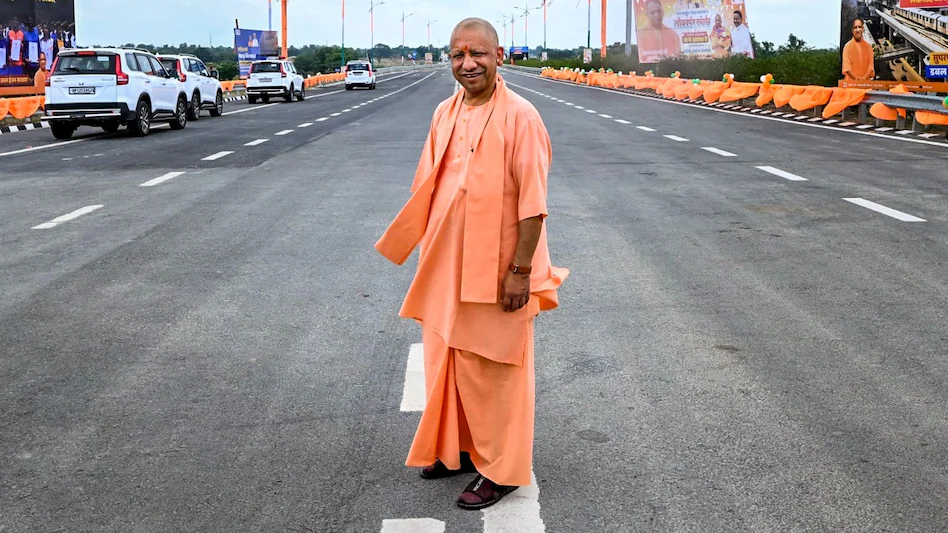
In the political challenge of constructing expressways in UP, Yogi Adityanath has surged ahead at great speed. (File Photo: PTI)
Prime Minister Narendra Modi inaugurated the 594-km-long Ganga Expressway on Wednesday April 29, 2026 . With this event, a monumental developmental achievement is poised to be credited to Yogi Adityanath—a feat that could finally put an end to the debate between Akhilesh Yadav and Yogi Adityanath in UP regarding who has built more expressways.
There was a time in Uttar Pradesh politics when elections revolved almost exclusively around issues of ‘caste’ and ‘religion.’ However, over the last decade, UP’s political landscape has shifted its focus to ‘speed’ and ‘roads.’ Today, Uttar Pradesh can aptly be described as the ‘Expressway State.’
Two names stand out most prominently in this race: first, Akhilesh Yadav, who set a new ‘benchmark’ for development with the Agra-Lucknow Expressway; and second, Yogi Adityanath, who has left that benchmark miles behind by extending the expressway network to every corner of the state. The inauguration of the Ganga Expressway on Wednesday April 29, 2026 has written a new chapter in this saga.
In the 2012 UP elections, the issue of ‘Expressway Credit’ was a major point of contention in the war of words between Yogi Adityanath and Akhilesh Yadav. The Purvanchal Expressway was ready—a project Akhilesh touted as a ‘Samajwadi initiative,’ while Yogi laid claim to having facilitated its construction. However, by the time the elections are held in 2027, much water will have flowed down the ‘river of expressways.’
The Ganga Expressway has drawn a definitive line across Uttar Pradesh’s infrastructure map, posing a formidable challenge to Akhilesh Yadav’s claims regarding development.
The Ganga Expressway, which Prime Minister Narendra Modi inaugurated on Wednesday, April 29, is set to give a tremendous boost to Yogi Adityanath’s political momentum.
Ganga Expressway: Yogi’s Masterstroke That Changed the ‘Game’
Spanning approximately 594 kilometers, this expressway is not merely a concrete road; rather, it serves as the Yogi government’s ‘Brahmastra’—a strategic weapon that has directly linked Western UP with Eastern UP. Originating in Meerut and extending all the way to Prayagraj, this expressway ranks among the longest expressways in the country.
The greatest strength of this project lies in its speed and scale. While during Akhilesh Yadav’s tenure, expressways were primarily centered around Lucknow and Agra, the Ganga Expressway has brought districts—such as Hapur, Bulandshahr, Amroha, Sambhal, Badaun, Shahjahanpur, Hardoi, Unnao, Raebareli, and Pratapgarh—into the mainstream of development; districts that had remained neglected for decades.
Yogi vs. Akhilesh: A War of Words
In the politics of Uttar Pradesh, there has always been a fierce race to claim credit for expressways. Akhilesh Yadav has frequently asserted at public rallies, “It was on the very expressways built by us that Baba Chief Minister’s aircraft landed.”
He often takes a jibe at the BJP, suggesting that they are merely inaugurating projects originally executed by his administration.
Yogi Adityanath, however, offers an even sharper retort. He argues, “Under previous governments, expressways served merely as a means to ‘make money’ and were confined to a select few districts. We have liberated expressways from the clutches of corruption and transformed them into ‘engines of growth’ for the entire state.”
The war of words between the two camps intensified further when the ‘Samajwadi Purvanchal Expressway’ was renamed simply as the ‘Purvanchal Expressway.’ However, with the Ganga Expressway, Yogi Adityanath has demonstrated that he is not merely completing projects initiated by his predecessors, but is working towards a vision far grander than theirs.
As the construction of the Ganga Expressway neared completion in record time, a common sentiment emerged within political circles: that Akhilesh Yadav now has very little room left to maneuver in the political game of claiming ‘expressway credit.’
UP’s Expressways: The ‘Credit Meter’ and Lengths
To understand Uttar Pradesh’s expressway network, it is essential to examine who built what:
Yamuna Expressway (165 km): The credit for this goes to Mayawati. She significantly reduced the travel distance between Noida and Agra. Although the inauguration was performed by Akhilesh Yadav, the vision and the actual groundwork were the achievements of the BSP government.
Agra-Lucknow Expressway (302 km): This was Akhilesh Yadav’s ‘dream project.’ It was constructed in a record-breaking 22 months. It drastically reduced the travel time between Lucknow and Delhi.
Purvanchal Expressway (341 km): Yogi Adityanath oversaw its construction. It connected Eastern UP (specifically Ghazipur and Azamgarh) with Lucknow. While Akhilesh continued to claim it as his own initiative, it was the Yogi government that successfully executed the project on the ground.
Bundelkhand Expressway (296 km): Entirely a contribution of the Yogi government. It serves as a vital lifeline connecting the underdeveloped Bundelkhand region to Delhi.
Ganga Expressway (594 km): Yogi Adityanath’s most ambitious project. In terms of sheer length, it has surpassed all other expressways in the state.
Who Benefits from the Ganga Expressway, and How?
This expressway is a ‘game-changer’ for Uttar Pradesh’s economy. Its benefits include:
Logistics and Trade: The journey between Meerut and Prayagraj—which previously took 12 to 14 hours—will now be completed in just 6 to 7 hours. This will make freight transport and logistics both faster and more cost-effective.
Industrial Corridors: The Yogi government is developing ‘industrial corridors’ along the route of the expressway. This initiative will generate employment opportunities for local youth and help curb rural-to-urban migration.
Benefits for Farmers: Farmers in agrarian districts such as Shahjahanpur, Badaun, and Hardoi will be able to transport their produce to markets in Delhi and Prayagraj within a matter of hours.
Emergency Airstrip: An airstrip has been constructed near Shahjahanpur to facilitate the landing of fighter jets during times of war or natural disasters. This feature holds significant importance from the perspective of national security.
Which Problems Has the Expressway Helped Resolve? There was a time when traveling between cities in UP felt like a ‘punishment.’ Expressways have put an end to these problems. There is no longer a need to enter the core areas of major cities, which has resulted in smoother traffic flow within urban centers. Improved road quality has boosted vehicle mileage and is saving precious time.
As far as connectivity is concerned, the very concept of ‘distance’ has now become obsolete for UP. You can leave Lucknow in the morning and have lunch in Delhi by the afternoon.
What remains to be done?
Although a vast network of roads has been laid out, several challenges still persist:
Safety and Amenities: Curbing the menace of stray animals on expressways, as well as preventing accidents caused by high-speed driving, remains a major challenge. Additionally, the number of wayside amenities—such as quality restaurants and petrol pumps—needs to be further increased.
Industrialization: While the roads have been built, the pace of establishing factories along their corridors must be accelerated to truly usher in an ‘economic revolution.’
Last-Mile Connectivity: The link roads connecting the expressways need to be further strengthened to ensure that even residents of rural areas can fully reap the benefits of this infrastructure.
The Ganga Expressway has significantly bolstered Yogi Adityanath’s standing in UP politics. What Akhilesh Yadav had initiated as an expressway project, Yogi transformed into a ‘Grand Mission.’ Today, when we look at UP’s expressways, it is abundantly clear that Yogi has set a new, high benchmark for development. The race is no longer about claiming credit, but rather about leveraging this infrastructure to transform UP into a ‘One Trillion Dollar Economy.’

YOU MAY LIKE THIS