Reg No. - CHHBIL/2010/41479ISSN - 2582-919X

Big Deals of India: A Counter to Trump’s Tariffs… Modi Government Strikes ‘Special Deals’ with 9 Countries in 6 Years-By-Kumar Bahukhandi
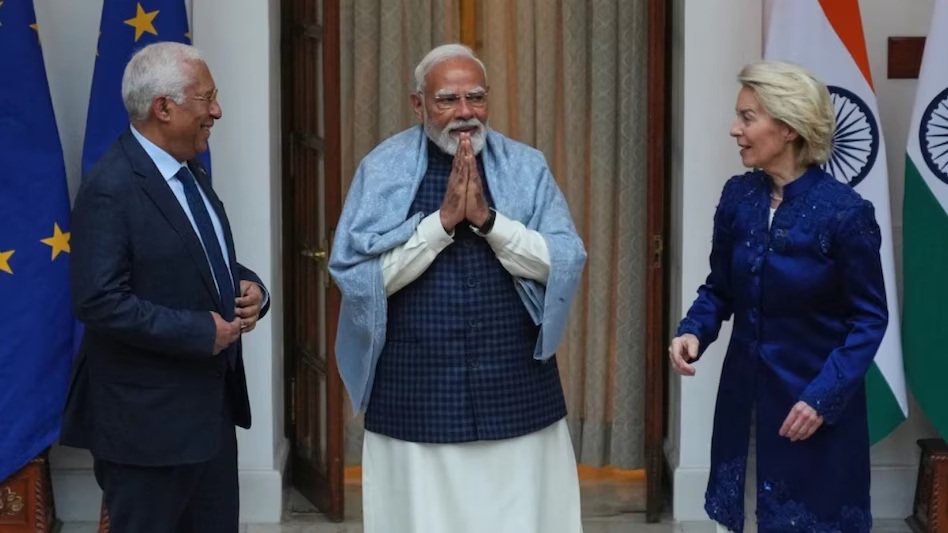
India signs agreements with several countries amidst global challenges. (Photo: AP)
Big Deals of India: Amidst various global challenges, and in line with its strategic approach, India has concluded a series of major deals. Over the past six years, the Modi government has signed FTAs with partners ranging from Mauritius and Oman to the European Union and New Zealand.
Whether it be the war between Russia and Ukraine, the conflict between Israel and Palestine, the standoff between the US and Iran, or the looming threat of Trump’s tariffs, numerous global challenges have emerged over the past few years; yet, the momentum of the Indian economy has remained robust.
The world has acknowledged India’s mettle—and rightly so—for while the rest of the globe grappled with risks ranging from trade disruptions to inflation, the Modi government delivered one remarkable success after another. This can be gauged from the fact that, over the last six years, India has signed Free Trade Agreements (FTAs) with nine nations—pacts that have proven to be an effective counter to US tariffs. The most recent of these agreements was concluded with New Zealand.
The rapid succession of Free Trade Agreements (FTAs) being signed by the government with various nations is not only opening up new and expansive markets for the export of Indian goods but is also simultaneously reducing India’s limited dependence on imports. Furthermore, these agreements have paved the way for increased investment inflows into India and are proving effective in generating greater employment opportunities.
FTAs Ranging from the UK to the EU
Prior to this, India has signed Free Trade Agreements with a number of countries. These include FTAs concluded with partners ranging from Mauritius and the United Kingdom to the European Union (EU).
No. 1: The Modi government signed an agreement (India-Mauritius FTA) with Mauritius; this marked the first instance of India entering into an FTA with an African nation.
No. 2: In 2022, a Free Trade Agreement was signed between India and the United Arab Emirates. In line with the targets established under this FTA, bilateral trade between the two countries is projected to reach $100 billion by FY 2025.
Number 3: In 2022 itself, India finalized another deal. This time, a consensus was reached between India and Australia on a Free Trade Agreement (FTA), and it was formally signed. This marked India’s first such FTA in which tariffs were completely eliminated (zeroed out) on 100 percent of its exports.
Number 4: On March 10, 2024, a Trade and Economic Partnership Agreement (TEPA) was signed between India and the EFTA nations (Switzerland, Norway, Iceland, and Liechtenstein). This agreement came into effect on October 1, 2025. Its objective was to attract $100 billion in investment to India over a period of 15 years.
Number 5: In 2025, an agreement was reached between India and the United Kingdom. In July, the two nations signed a historic Free Trade Agreement (FTA). Under this FTA, the path was paved for 99% of India’s exported goods to gain duty-free access to the UK market. Furthermore, the deal aims to boost bilateral trade between India and the UK to $120 billion by 2030.
Number 6: Towards the end of 2025—specifically in December—the Modi government successfully concluded yet another deal. Amidst the global apprehension surrounding the “Trump Tariffs,” a Comprehensive Economic Partnership Agreement (CEPA) was signed between India and Oman. Under this agreement, Oman will grant India tariff-free access across 98.08% of its tariff lines; this covers 99.38% of the goods exported by India to Oman. Conversely, India has offered tariff concessions on 77.79% of its own tariff lines, covering 94.81% of the goods imported from Oman.
Number 7: At the beginning of 2026—specifically in January—India concluded a historic deal with the European Union. The India-EU FTA was hailed as the “Mother of All Deals.” Under this agreement, Indian exporters gained access to zero-tariff exports within EU member nations. This deal is particularly advantageous for the textiles and apparel sector; following the United States, the EU represents the largest market for Indian exports in this segment, valued at over ₹22 lakh crore. Furthermore, under the terms of this agreement, both parties consented to open their respective markets to one another, announcing the reduction or complete elimination of tariffs on up to 90 percent of their products.
Number 8: In February 2026, a consensus was reached on the framework for an interim trade agreement between India and the United States—a nation known for its use of tariffs to exert global pressure. Both countries expressed agreement on a range of issues. The U.S. lifted the additional 25 percent tariff previously imposed on India in response to its purchase of Russian oil; additionally, reciprocal tariffs were reduced from 25 percent to 18 percent, effective February 7.
Number 9: India’s most recent Free Trade Agreement (FTA) has been concluded with New Zealand, with the pact officially signed on April 27. The India-New Zealand FTA was signed by India’s Union Minister of Commerce, Piyush Goyal, and New Zealand’s Minister for Trade, Todd McClay. A particularly noteworthy aspect of this agreement is that it was finalized in a remarkably short span of just nine months. This Free Trade Agreement is expected to come into force by the end of this year.
Under the FTA, New Zealand will grant India zero-tariff access to its market, and approximately 95% of exports from India will enter either tariff-free or subject to reduced tariffs. The objective of this deal is to double bilateral trade between the two nations, taking it to $5 billion. Furthermore, New Zealand is set to invest $20 billion in India over the next 15 years.

YOU MAY LIKE THIS