Reg No. - CHHBIL/2010/41479ISSN - 2582-919X

Women-Led Development in India: From Empowerment to Leadership
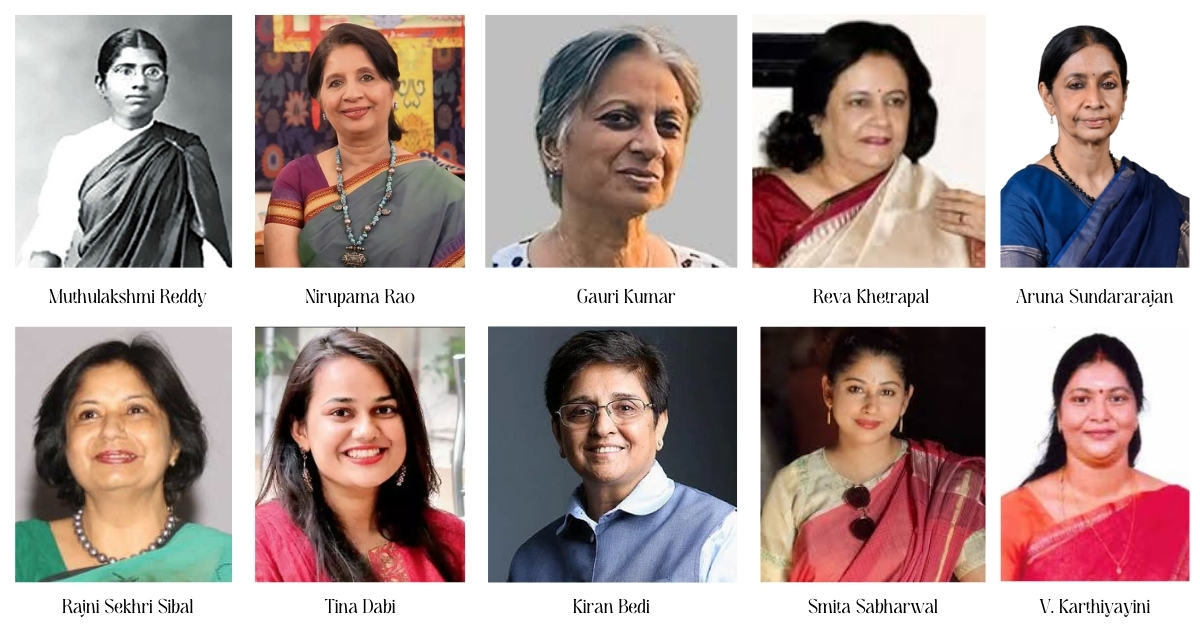
India’s top10 women administrators ,who transformed governance and leadership – Representational Image
- The Government is working towards positioning women in self-reliant and decision-making roles.
Raipur: The objective of women’s empowerment in India is to render women socially, economically, and politically independent, educated, and endowed with equal rights. Initiatives such as Beti Bachao, Beti Padhao (Save the Daughter, Educate the Daughter), the Mudra Yojana, and women’s reservation policies have significantly increased their participation in decision-making processes.
Although patriarchal mindsets and security challenges persist, education and legal reforms are gradually bringing about change.
The concept of women’s empowerment in India has now evolved into a comprehensive and life-cycle-based approach, wherein women’s needs—spanning from birth to education, health, livelihood, and leadership—are being addressed holistically.
The various schemes administered by the Government of India are no longer confined merely to welfare; rather, they are actively working towards positioning women in self-reliant and decision-making roles. This transformation reflects India’s developmental journey—moving from “Welfare” to “Empowerment,” and now towards “Women-Led Development.”
In the realm of health and nutrition, initiatives such as Mission Poshan 2.0, the Pradhan Mantri Matru Vandana Yojana (PMMVY), and the Pradhan Mantri Surakshit Matritva Abhiyan have ensured significant improvements.
From 2017 through February 2026, conditional financial assistance amounting to ₹20,101 crore has been provided to approximately 4.27 crore women under the Pradhan Mantri Matru Vandana Yojana. Concurrently, under the Pradhan Mantri Surakshit Matritva Abhiyan, free medical check-ups have been conducted for over 7.26 crore pregnant women.
Across the country, nutritional services are reaching over 8.97 crore beneficiaries through a network of 14.03 lakh Anganwadi centers; furthermore, owing to the impact of Mission Indradhanush, the child mortality rate has declined from 48 to 28, while the neonatal mortality rate has dropped from 28 to 17. Under the “Poshan Bhi Padhai Bhi” (Nutrition and Education) program, 8.55 lakh workers have been trained, and 1.03 lakh centers have been upgraded through the Saksham Anganwadi Scheme.
In the realm of financial inclusion, the Pradhan Mantri Jan Dhan Yojana, Pradhan Mantri MUDRA Yojana, and Stand-Up India Scheme have played a pivotal role in economically empowering women.
Under the Pradhan Mantri Jan Dhan Yojana, out of a total of 57.93 crore accounts, 32.29 crore accounts are held in the names of women—a significant achievement in the direction of financial inclusion. Under the Pradhan Mantri MUDRA Yojana, approximately 68 percent of the total loans disbursed have been granted to women, amounting to a total sum exceeding ₹14.72 lakh crore. Under the Stand-Up India Scheme, 83 percent of the beneficiaries of sanctioned loans are women, with the total amount exceeding ₹47,704 crore.
Under the Deendayal Antyodaya Yojana–National Rural Livelihoods Mission, 10.05 crore women have joined Self-Help Groups, while through the “Lakhpati Didi” initiative, 3.07 crore women have advanced towards becoming self-reliant. Under the “Namo Drone Didi Yojana,” 1,094 drones have been distributed, thereby connecting women with modern technology as well.
To ensure dignity in daily life, schemes such as the Pradhan Mantri Awaas Yojana–Rural, Pradhan Mantri Ujjwala Yojana, Swachh Bharat Mission, and Jal Jeevan Mission have brought about transformative changes. Under the Pradhan Mantri Awaas Yojana–Rural, over 2.90 crore houses have been allotted in the names of women, thereby bolstering their social and economic empowerment. Under the Ujjwala Yojana, over 10.5 crore gas connections have been provided, offering women freedom from smoke and resulting health benefits.
Under the Swachh Bharat Mission, over 12.11 crore toilets have been constructed, ensuring the dignity and safety of women. Through the Jal Jeevan Mission, tap water facilities have been extended to over 15.83 crore households, leading to a significant reduction in the daily physical labor undertaken by women. In the fields of education and skill development, initiatives such as Beti Bachao Beti Padhao, the Sukanya Samriddhi Yojana, and Kasturba Gandhi Balika Vidyalayas have ensured positive change.
As a result of the Beti Bachao Beti Padhao campaign, the sex ratio at birth has risen from 918 to 929. Under the Sukanya Samriddhi Yojana, more than 46 million accounts have been opened, holding deposits totaling over ₹3.40 trillion. Currently, more than 758,000 female students are studying across 5,316 Kasturba Gandhi Balika Vidyalaya schools. In higher education, the Gross Enrolment Ratio (GER) for women has reached 30.2 percent, while a 135.6 percent increase has been recorded in the enrolment of women in PhD programs. Under the AICTE Pragati scheme, 35,998 female students have benefited, and over 80,000 students have received encouragement through the Vigyan Jyoti scheme.
For the safety and security of women, work is being undertaken under the Mission Shakti initiative, focusing on two key pillars: “Sambal” and “Samarthya.” The number of One Stop Centres has reached 926, providing assistance to over 1.39 million women. Furthermore, 9.91 million women have received support through the Women’s Helpline services (181 and 112).
The SHe-Box portal has connected 163,000 workplaces, thereby ensuring the safety of women in the workplace. Meanwhile, under the “Samarthya” component, 416 Shakti Sadans and 531 Sakhi Niwas facilities are being operated to provide safe shelter and rehabilitation services to women.
Ultimately, women’s empowerment in India has now evolved beyond the mere implementation of schemes to become the very foundation of a comprehensive socio-economic transformation.
Today, women serve not only as the linchpin of their families and society but also play a leading role in shaping the trajectory of the nation’s economic, social, and technological progress.
This constitutes the true essence of “Women-Led Development”—a paradigm where the power of women serves as the bedrock of national strength.

YOU MAY LIKE THIS