Reg No. - CHHBIL/2010/41479ISSN - 2582-919X

After Iran, Is It Now Pakistan’s Turn? Why Nuclear Bombs Are Being Discussed in the US

US Intelligence Chief Tulsi Gabbard has issued a warning regarding Pakistan’s missile program and nuclear weapons. (File Photo: Pixabay/Reuters)
Will the US now target Pakistan after Iran? This question arises because the US is increasingly concerned regarding Pakistan’s missile and nuclear weapons programs. There is apprehension that the US might take stringent measures concerning Pakistan’s nuclear arsenal. Currently, Pakistan possesses 170 nuclear bombs, and its missile program is advancing rapidly.
These days, Pakistan’s nuclear bombs and missiles are a subject of intense discussion within the United States. On March 18, 2026, Tulsi Gabbard, the US Director of National Intelligence, warned the Senate that Pakistan is developing long-range missiles capable of reaching the US mainland.
She categorized Pakistan—alongside Russia, China, North Korea, and Iran—as one of the most significant nuclear threats. The fact that Pakistan’s name has surfaced immediately after Iran’s has sparked fear across the United States. However, the central questions remain: How many nuclear bombs does Pakistan actually possess? And do they pose a genuine threat to the United States?
Tulsi Gabbard’s Warning and US Apprehensions
Tulsi Gabbard stated that Pakistan—along with Russia, China, North Korea, and Iran—is developing new missiles capable of carrying either nuclear or conventional warheads. These missiles have the potential to strike targets on US soil. Currently, the US faces a threat from over 3,000 missiles; however, by 2035, this figure could surge to 16,000.
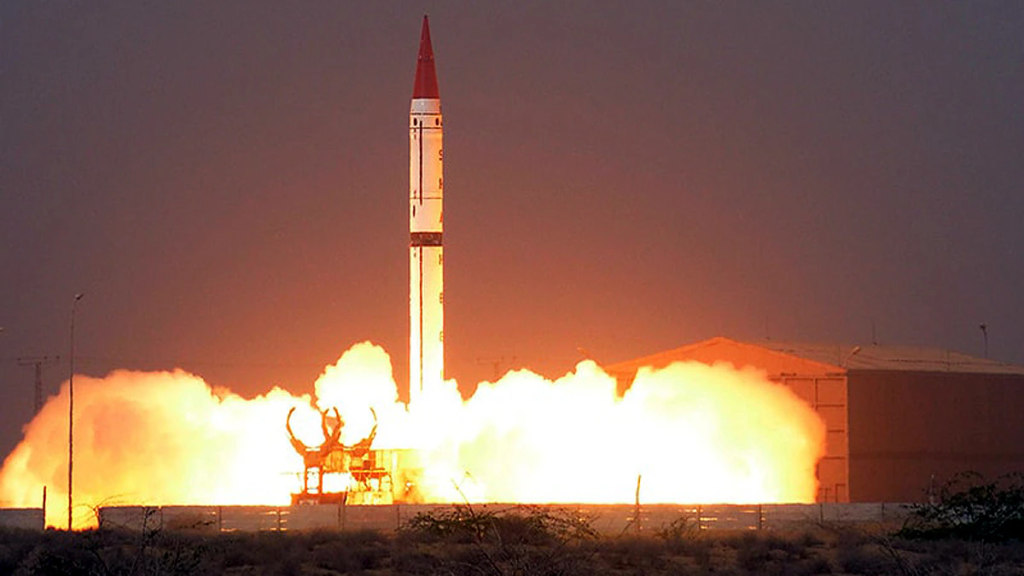
The United States fears that Pakistan’s long-range ballistic missiles (ICBMs) could reach American territory. Iran’s name previously featured prominently in discussions due to its nuclear program and missile capabilities; however, Pakistan’s missile program is now becoming a source of greater concern for the United States.
The U.S. asserts that while this development in Pakistan was initially undertaken as a measure against India, it now poses a potential threat to the United States as well.
How many nuclear bombs does Pakistan possess?
According to SIPRI and the Federation of American Scientists (FAS), as of March 2026, Pakistan possesses approximately 170 nuclear bombs. This figure has remained relatively stable over the past several years. Some experts suggest that this number could reach 200 by the end of the century.
These bombs fall into two categories: those made using uranium (HEU) and those made using plutonium. Pakistan ranks as the world’s seventh-largest nuclear-armed nation. Its arsenal comprises both tactical nuclear weapons—designed for use in limited battlefield scenarios—and strategic weapons, intended for long-range strikes.

Pakistan’s Nuclear Missiles – Can They Reach the United States?
Pakistan’s most significant missiles are as follows:
Shaheen-III – Range: 2,750 kilometers; solid-fueled; capable of immediate launch. It covers the entirety of India.
Ababeel – Range: 2,200 km; features MIRV technology—a single missile can deliver multiple warheads to different targets.
Ghauri – Range: 1,500–2,300 kilometers; an older system, yet still in active service.
The United States asserts that Pakistan is moving beyond these systems to develop much larger rocket motors, which will facilitate the creation of ICBMs (Intercontinental Ballistic Missiles) with a range exceeding 5,500 km. The distance between Pakistan and the United States is approximately 12,000 kilometers; therefore, if an ICBM is successfully developed, a nuclear strike reaching the U.S. would become a possibility.
Pakistan’s entire nuclear program was originally initiated as a deterrent against India; however, it is now expanding rapidly. In addition to increasing the size of its nuclear arsenal, Pakistan is also actively enhancing the capabilities of its missile systems.
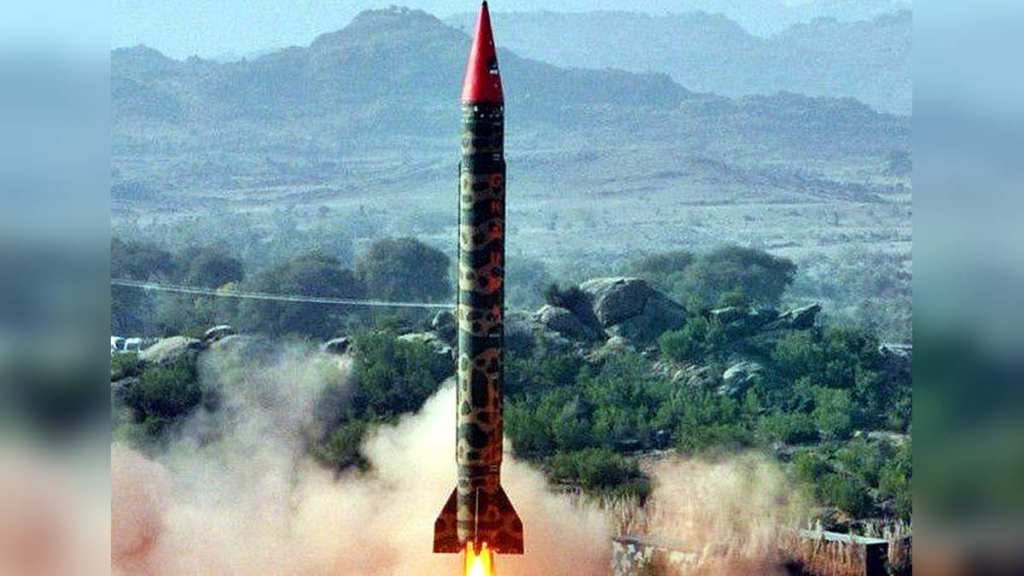
Why is the U.S. So Concerned?
Previously, Pakistan’s missiles were limited solely to India; however, its long-range missiles now pose a threat to the United States as well. Tulsi Gabbard has explicitly stated that Pakistan’s missile program is trending toward the development of ICBMs.
This discussion is gaining traction in the U.S. against the backdrop of ongoing tensions with Iran. Now, Pakistan has also been added to that list. While Pakistan already possesses nuclear warheads, its delivery systems—specifically its missile program—are becoming increasingly robust. Consequently, the threat level is escalating.
Although Pakistan maintains that this program is purely defensive in nature and poses no threat to the United States, U.S. intelligence agencies are taking the matter very seriously.
Also Read: Why is Kabul’s Camp Phoenix in Pakistan’s Crosshairs? Its Connection to the U.S. Military
What Happens Next?
With Pakistan’s name surfacing alongside Iran’s, the debate regarding nuclear weapons has intensified within the United States. Pakistan currently possesses 170 nuclear warheads, and its missile program is advancing rapidly. Following Tulsi Gabbard’s warning, the U.S. has become even more vigilant. While Pakistan’s ICBM is not yet fully operational, the development program is actively underway.