Reg No. - CHHBIL/2010/41479ISSN - 2582-919X

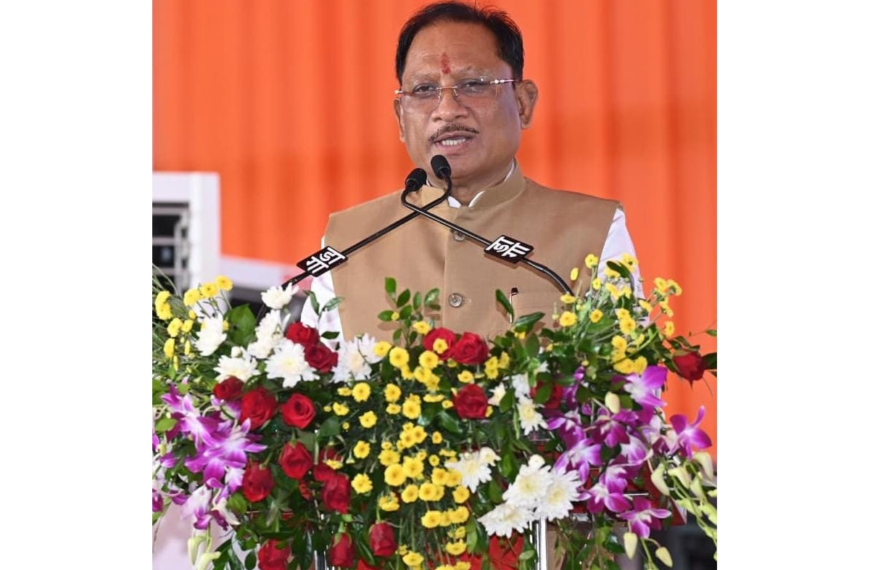
Republic Day Message of Chief Minister Vishnu Deo Sai, Bilaspur Monday January 26, 2026
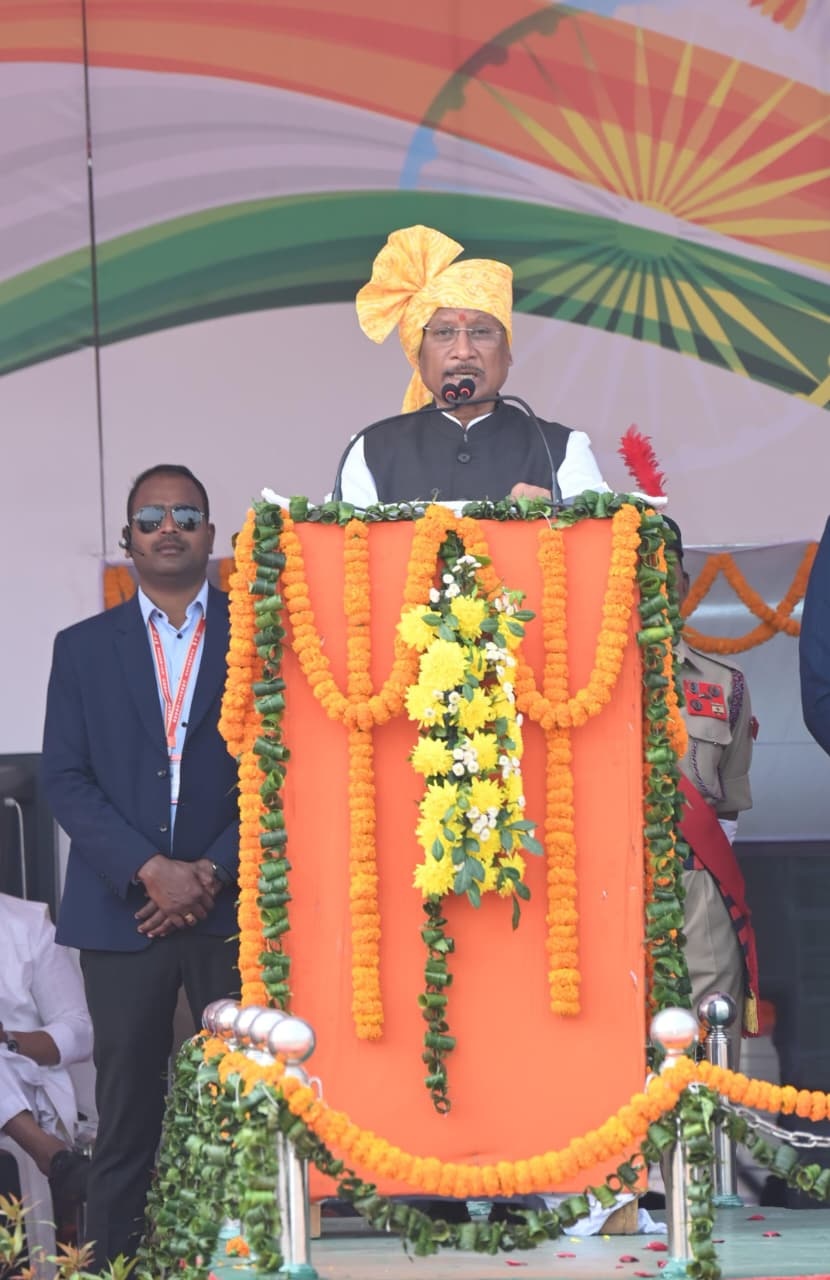
Greetings to all mothers, sisters, elders, youth, and children.Today we are celebrating the 77th Republic Day.Hearty congratulations and best wishes to all of you on Republic Day.
As far as my eyes can see, the glory of the tricolor is visible everywhere. Every child of Mother India seems filled with joy. Nationalism is surging in the heart of every citizen. The flame of resolve for nation-building is burning within every citizen.
On this auspicious occasion of Republic Day, I extend my heartfelt greetings to these brave children of Mother India.
Today is a day to celebrate the joys of this national festival. Today is a day to remember our great leaders who sacrificed their lives for the nation. We are all grateful to all those freedom fighters who struggled hard for independence and made India the world’s largest republic.
On this day, we remember our constitution makers. Our Constitution, drafted by Baba Saheb Dr. Bhimrao Ambedkar, inspires us to imbibe the message of equality for all, given by Baba Guru Ghasidas Ji. In the Indian tradition, great saints like Tulsidas and Kabirdas placed freedom of expression above all else in the system of governance. Our Constitution grants this right to every citizen.
The Indian Republic has created an open society in which every citizen can express their views for nation-building. Today, all citizens of the country celebrate these rights granted by the Constitution.
We recently celebrated the Silver Jubilee of the state’s formation. Our former Prime Minister, Bharat Ratna, the revered Atal Bihari Vajpayee Ji, gifted us the state of Chhattisgarh. We have celebrated his birth centenary year as the Atal Nirman Year.
On the occasion of the Silver Jubilee, the new building of our Legislative Assembly, the temple of the Constitution, was inaugurated by the Successful Prime Minister Narendra Modi Ji.
This building, a symbol of our democratic faith, truly represents the identity of Chhattisgarh. The architecture of this building, enriched by the design of paddy ears and the folk art of Bastar and Surguja, reflects the essence of Chhattisgarh’s soil.
25 years ago, the first session of our Legislative Assembly was held in the Jashpur Hall of Rajkumar College in Raipur. Along with the state, the Assembly also celebrated the silver jubilee of its rich tradition. Many democratic traditions were established here, which have been emulated by the legislative assemblies of other states.
This year, we also celebrated the 150th anniversary of the national song Vande Mataram. We held a special discussion in the newly constructed Assembly building on the contribution of Vande Mataram to nation-building.
From Konta in Sukma district to Sitamarhi Harchauka in Manendragarh-Chirmiri-Bharatpur district, people in every corner of the state sang Vande Mataram in unison. This honor bestowed upon our national song, written in praise of Mother India, is a true tribute to Bankim Chandra Chatterjee.
This year also marks the 125th birth anniversary of Dr. Syama Prasad Mukherjee. Through the principle of one nation, one flag, one constitution, he sacrificed his life for the integrity of Mother India. When Article 370 was abrogated from Jammu and Kashmir, it was a true tribute to Dr. Mukherjee from the nation.
This time, on the occasion of Tribal Pride Day, we also celebrated the 150th birth anniversary of Dharti Aaba Bhagwan Shri Birsa Munda.
Bhagwan Shri Birsa Munda instilled a sense of self-respect in the tribal community. He waged a fierce struggle against British exploitation and colonial laws and made the ultimate sacrifice.
The land of Chhattisgarh has also witnessed tribal uprisings against British exploitation. Tribal heroes made significant contributions to the freedom struggle through the Jungle Satyagraha.
We are narrating the story of the sacrifices made by the tribal heroes of Chhattisgarh in the freedom struggle through digital means. The Shaheed Veer Narayan Singh Tribal Freedom Fighter Museum was also inaugurated by Prime Minister Narendra Modi on the occasion of State Foundation Day.
This is the country’s first digital museum. This museum, which showcases the character of our tribal heroes who sacrificed their lives for the nation’s identity, is like a pilgrimage site for today’s generation.
Large numbers of people gather here and are filled with reverence for their heroes.
“Fairs will be held every year at the pyres of the martyrs; this will be the only remaining mark of those who died for their country.”
Today, we salute our brave soldiers who risked their lives to liberate our land from the threat of Maoism.
The violent ideology of the Maoists poses a great challenge to the country’s democracy. They have no faith in the Constitution, in the nation’s identity, or in the symbols of national identity. The only solution to this cancerous disease is to eradicate it completely.
Under the leadership of the Prime Minister and the guidance of Union Home Minister Amit Shah, we challenged the Maoists by adopting a well-planned strategy.
Our soldiers, facing danger at every moment in harsh weather and difficult terrain, carried out area domination day and night and achieved every objective with their courage and valor.
This extremely difficult goal of ending Maoist violence is now nearing completion. By March of this year, we will completely eliminate Maoism from this beautiful land.
The good news is that many who had strayed from the right path are now returning to the mainstream of democracy.
They laid down their weapons and held Baba Saheb’s Constitution in their hands. This was the most beautiful sight witnessed in the land of the Father of the Nation, Mahatma Gandhi, and it reinforced the spirit of “Satyameva Jayate” (Truth alone triumphs) enshrined in the Constitution.
A few months ago, when I went to Jagdalpur to attend an event, I visited the Bastar Cafe, which is now run by surrendered Naxalite women. I have no words to describe the joy I saw on their faces as they left the path of violence and embraced the path of service to the people.
Every dark night is followed by a new dawn. Now, the sun of development is shining brightly in the Naxal-free region. The shadow of fear has lifted from the children’s faces; books are in their hands. It is wonderful to see Bastar in this new form.
The silver jubilee of a state is also an opportunity for introspection. The test is how well we have lived up to the ideals set by our ancestors.
The society of Chhattisgarh, following the path shown by its ancestors, is dedicated to serving Chhattisgarh Mata (Mother Chhattisgarh) with the spirit of “Sabka Saath, Sabka Vikas, Sabka Vishwas aur Sabka Prayas” (Together with all, development for all, trust of all, and efforts of all).
During India’s First War of Independence, the torch of rebellion in Chhattisgarh was lit by brave heroes like Shaheed Veer Narayan Singh. He not only opposed the British colonial rule but also showed the way to an alternative system that had deep compassion for the poorest of the poor.
He opposed hoarding and quenched the hunger of people suffering from famine. Chhattisgarh’s PDS model is a true tribute to Shaheed Veer Narayan Singh.
We have a saying here: “For the weak, even two Ashadha months are difficult.” This proverb clearly illustrates the difficulties faced by our farmer brothers and sisters, showing how challenging farming is.
After the formation of the state, our biggest challenge was the happiness and satisfaction of our farmers. In this silver jubilee journey, we have brought back the smiles to the faces of our farmer brothers and sisters. Today, the farmers of Chhattisgarh are getting the best price for their paddy.
In our rural areas, prosperity is measured by the granaries in people’s homes. When granaries are full of grain, you can understand that prosperity is widespread.
Our state’s granary, our rice bowl, is overflowing with paddy. After the formation of the state, paddy procurement was systematically organised. When paddy procurement began, the figure was 500,000 metric tons; last time, this figure reached 14.9 million metric tons. In the last two years, we have transferred ₹1.5 lakh crore to farmers’ accounts through farmer-friendly schemes.
Our government makes decisions in the best interest of farmers. Under the Atal Irrigation Scheme, we have approved a ₹2,800 crore plan to complete 115 irrigation projects that had been incomplete and pending for years.
The GST reforms implemented by the Prime Minister on Diwali have benefited our farmer brothers the most. Tractors and other agricultural equipment have become significantly cheaper. It has been a very busy time for businesses selling agricultural machinery.
The biggest benefit of reducing taxes on agricultural products is that our farmer brothers are rapidly adopting modern farming techniques.
Rice from our Chhattisgarh is exported to 120 countries. Reduced costs and good prices offered by the government help farmers keep their products competitive.
Our country is also engaged in trade negotiations with other countries. These negotiations are also taking place with superpowers. The Prime Minister has clearly stated that farmers will not be harmed in any way by any trade agreements.
The double-engine government never bows down on farmers’ issues; it stands tall on farmers’ issues and ensures that our farmer brothers get their rights.
The prosperity of farmers and our labor brothers is our top priority. In two years, our government has transferred more than ₹800 crore to over 2.9 million laborers through various schemes.
Keeping in mind the objective of women’s empowerment, provisions have been made for the conditional employment of women workers in night shifts as well. In just two years, the number of insured workers under the Employees’ State Insurance Act has increased from 460,000 to 626,000. The four labor codes that the central government has introduced, replacing 29 old labor laws, are being implemented rapidly in the best interest of our working brothers and sisters.
Our government has completed two years. Fulfilling Modi ji’s guarantee, we decided in the very first cabinet meeting to sanction 1.8 million houses. More than 2.6 million Pradhan Mantri Awas Yojana (Prime Minister’s Housing Scheme) houses have been sanctioned in the state so far.
We are carrying out this work of providing housing to the people in a mission mode. I am very happy to tell you that approximately 2,000 houses are being built in the state every day.
This pace is the fastest in the entire country. You are all witnesses to the housing revolution taking place in Chhattisgarh. Thatched roofs are now a thing of the past; every house is now a permanent structure with basic amenities, and clean water is being provided through the Jal Jeevan Mission.
Before the formation of the state, the people of the region faced hours of power cuts. In terms of electricity generation, we are currently second in the country and are rapidly moving towards the first position. Today, BPL (Below Poverty Line) families in the state are receiving free electricity under the single-bulb scheme, and the remaining families are getting electricity at subsidised rates 24 hours a day.
In the energy sector, we are working in line with the needs of a developed India and a developed Chhattisgarh. In this regard, the Prime Minister laid the foundation stone for a Super Thermal Power Project worth ₹9790 crore in Sipat. The double-engine government’s focus is on achieving the net-zero carbon emission target, and accordingly, we are working on city gas distribution pipelines in districts like Koriya, Surguja, and Balrampur.
Under the Pradhan Mantri Solar Ghar Muft Bijli Yojana (Prime Minister’s Solar Home Free Electricity Scheme), the state government is also providing subsidies along with the central government, due to which a large number of people have registered for renewable energy. We have also signed an MoU with GAIL, which focuses primarily on a gas-based fertiliser project, specifically a urea production plant with a capacity of 12.7 lakh metric tons per year.
The implementation of schemes in Bastar had slowed down due to Naxalism, but now it has gained momentum. Naxalism has rendered people homeless. We are providing permanent houses to those who have given up arms and returned to the mainstream. We have sanctioned 15,000 houses for this purpose. Through the PM Janman Yojana, we have sanctioned 33,217 houses for particularly vulnerable tribal groups.
We have taken a pledge to beautify Chhattisgarh. Our mothers and sisters play the most significant role in shaping and beautifying Chhattisgarh. I am happy that, while giving full respect to women, our government is providing an honorarium of ₹1000 per month to approximately 70 lakh women through the Mahtari Vandan Yojana. So far, we have transferred ₹14,948 crore in 23 installments to the accounts of our mothers and sisters.
The Prime Minister has set a target of completely freeing the country from Macaulay’s mindset in the next ten years. India was once a world leader, but Macaulay’s mindset had such an impact on society that people started viewing every idea from a Western perspective and forgot the ideals of their Indian culture. This mindset can be changed through education imbued with Indian values.
When we took over the reins of the government, one of the biggest challenges before us was in the field of education. This was due to two reasons. Firstly, the online classes conducted because of COVID-19 resulted in significant learning loss for the children. Children were facing difficulties even with basic reading, writing, and arithmetic. Rectifying this learning loss was a major challenge, and we worked especially hard on this.
Secondly, and an even bigger problem, was the shortage of teachers in remote and rural areas. There were 453 schools with no teachers at all, and 1428 schools were running with only one teacher, even though our state has a better student-teacher ratio compared to the national average. Through rationalization, we transferred surplus teachers from urban areas to rural areas, and this problem was resolved.
Now, when I visit rural areas, people happily tell me that teachers have arrived at their schools and that the quality of education has improved. After the implementation of the National Education Policy, children are learning in their local languages, which is making learning much easier for them. We have implemented IT-based monitoring in schools through the Vidya Samiksha Kendra (Education Review Center). We are going to start 9,000 smart classrooms and install 22,000 computers in the state’s schools. A national-level PARAKH survey was recently conducted. The state’s performance in the survey has improved, and I would like to give credit for this to all the teachers.
We have also implemented the National Education Policy in higher education. Last month, we inaugurated the construction of a medical college building in Kabirdham. I believe that to understand Chhattisgarh’s journey towards its silver jubilee, one must understand the development of medical education here. Earlier, there was only one medical college in Raipur; now, 15 medical colleges have been sanctioned in the state. Our government has strengthened healthcare facilities through the Multi Super Specialty Hospital in Bilaspur. Land has also been identified for a government physiotherapy college in Koni. We have started providing MBBS education in Hindi. On the lines of IITs, we are going to establish technology institutions in Jashpur, Bastar, Kabirdham, Raipur, and Raigarh districts of the state.
Our young population is a great asset for us. We are bringing national-level institutions to the state. We are developing Nava Raipur as an EduCity. We are establishing institutions like NIFT, NIELIT, and a Forensic University here. To provide better places for young people to study, we are building state-of-the-art libraries in 34 urban bodies, on the lines of the Nalanda campus in Raipur. The government is making every possible effort to provide facilities ranging from skill training to modern courses for the youth. We have upgraded 160 ITIs into model ITIs at a cost of Rs. 484 crore. We are also working on skill upgradation through the Pan-IIT institution. Through the new startup policy, we have set a target of connecting 50,000 students with startups.
Our country has bid for the Olympic Games in 2036. This step has been taken to strengthen sports infrastructure and create a vibrant sporting environment in the country. To ensure that players from Chhattisgarh also showcase their talent at the international level in the Olympic Games, we are working on improving sports infrastructure in a mission mode. A budget of Rs. 85 crore has been allocated for a sports complex in Sector 28 of Nava Raipur. Our state is predominantly tribal. The art of archery has been an integral part of our tribal region’s identity.
To further enhance this, we have allocated 13 acres of land in Nava Raipur for the establishment of a National Archery Academy. To encourage the players, we have also announced special financial rewards for medal winners in the Olympic Games.
Sports competitions are never held in turbulent areas. Sports are played in a peaceful environment. Such peace has returned to Bastar as well. Through the organization of the Bastar Olympics, we have presented a new identity of Bastar to the country and the world through sports. Last year, 165,000 people participated in these games, and this time 292,000 people participated. This year, we have also been given the opportunity to host the Khelo India Tribal Games. The sports landscape in the state is bright, and we will continue to work towards its improvement.
The state’s new industrial policy has brought with it expectations of large-scale job creation for the young population. Under the new policy, we are providing investors with grants and other attractive facilities under the single-window system and ease of doing business framework. Under the new policy, we held investment conferences in metropolitan cities like Mumbai, Delhi, Ahmedabad, and Bengaluru, as well as in Japan and South Korea.
The Osaka World Expo, held in Japan, is one of the most important events in the world for entrepreneurs. Here, we set up a pavilion showcasing the unique features of Chhattisgarh and provided information about the new industrial policy and investment opportunities in Chhattisgarh. We provided all this information in Japanese, which was a unique experience for them. Investors from both countries showed interest in investing in Chhattisgarh. So far, we have received investment proposals worth ₹783,000 crore from across the country and the world, and work is progressing rapidly on these proposals.
We have created a State Capital Region and formed an authority for its rapid development. Due to systematic development and future planning, this region will be one of the fastest-growing industrial centers in the country and among the leading cities in terms of ease of living. We are also working on establishing a Global Capability Center here so that multinational companies from around the world can operate from here.
The future belongs to AI. With the abundant availability of energy, AI-related ventures will be centered in Chhattisgarh. We have launched the AI Data Center Park in Atal Nagar, Nava Raipur. Its location also makes it strategically important, as data can be transmitted to every corner of the country in the shortest possible time. Work has begun on the semiconductor unit. Along with being an IT hub, Nava Raipur is also emerging as a pharmaceutical hub. Once the Medicity is fully developed, Nava Raipur will be one of the most important medical hubs in the country.
Chhattisgarh is the second state in the country to introduce the Public Trust Bill, through which we have decriminalised many provisions. This has created an atmosphere of enthusiasm among entrepreneurs and business owners.
The scourge of Naxalism has significantly hampered the development of Bastar. Now, our biggest challenge is to bring Bastar into the mainstream of development by carrying out development work on a mission mode. For this, we have launched the Niyad Nella Nar scheme in villages that were previously severely affected by Naxalism. Under this scheme, 53 beneficiary-oriented schemes and 28 community facilities are being implemented in 403 villages within a 10-kilometer radius of 69 security camps, with the participation of 17 government departments.
When the survey for the Mahtari Vandan Yojana was first conducted, women in these areas could not benefit from the scheme due to the severe Naxalite influence. We conducted a fresh survey under this scheme, and now the mothers and sisters of these villages are also receiving the benefits of this scheme.
The double-engine government has put in unprecedented effort for infrastructure development in Bastar. Google is building Asia’s largest data center hub in Visakhapatnam at a cost of $15 billion. Visakhapatnam is being connected to Chhattisgarh through an expressway. This expressway will become the lifeline of Chhattisgarh’s prosperity and will help in taking Chhattisgarh’s products to the world through the port city.
The initiative to connect the Indravati and Mahanadi rivers will play a significant role in the development of Bastar. Along with building roads in the interior areas of Bastar and Surguja, we have launched the Chief Minister Bus Service scheme to provide public transport to the people. This service is being operated by local people. This is saving people a lot of time and has made access to facilities like education and healthcare easier.
Thanks to our efforts, tourists are returning to Bastar, the paradise on earth. This year, the Chitrakoot waterfall, known as the Niagara of Asia, witnessed a surge in the number of tourists during the New Year. To showcase the natural beauty of Bastar and its amazing tribal culture to the country and the world, we are organizing the Bastar Pandum again this year. Under the Swadesh Darshan scheme, we included Bhoramdev in Kawardha, and now work has begun on building a corridor there, similar to the Kashi Vishwanath corridor. We are extremely pleased that the Kopra reservoir in Bilaspur district has been declared Chhattisgarh’s first Ramsar site, which will help in conserving biodiversity.
Kalidasa drew inspiration for his masterpiece, the Sanskrit poem Meghaduta, from Surguja. The Surguja division is one of the most beautiful parts of the earth. We are working to promote tourism here. The number of tourists has also increased in Mainpat, which is known as the Shimla of Chhattisgarh. The new industrial policy, which grants industry status to tourism and offers attractive provisions for investment in homestays, is yielding excellent results. A large number of devotees are also visiting Madheshwar Mahadev, the largest natural Shiva lingam in Jashpur. Mayali in Jashpur has also been included in the Swadesh Darshan scheme.
The expansion of rail, road, and air services is evident in the rapid development of the Surguja division. Attractive provisions for investment here are leading to rapid economic growth. We are also improving the infrastructure related to education and health. ₹359 crore has been sanctioned for the establishment of a medical college in Jashpur. Along with this, ₹32 crore has been approved for the construction of a state-of-the-art 220-bed hospital.
We are working in mission mode to beautify urban areas and ensure basic amenities. This has yielded good results. All the cities of Chhattisgarh have performed well in the Swachh Survekshan (Cleanliness Survey). The Prime Minister also praised the sanitation workers of Bilha in his Mann Ki Baat program. Raipur received the award for the most promising clean city and a 7-star rating for Garbage Free Cities. Bilaspur secured the second position in the category of cities with a population of 3 to 10 lakhs.
Through the Chief Minister’s Urban Development Scheme, we are carrying out essential infrastructure works in all municipal corporations at a cost of ₹525 crore. Promoting public transport, the Prime Minister’s E-Bus Service Scheme has sanctioned 100 e-buses for Raipur, 50 for Durg-Bhilai, 50 for Bilaspur, and 40 for Korba. To commemorate Atal Ji’s birth centenary, we are establishing Atal Complexes in all urban local bodies.
We are continuously following the path of good governance shown by Atal Ji. Good governance has been adopted at every level of the administrative system. Transparency is the first condition of good governance, and embracing this, we have adopted digital governance at every level. Through e-office, we have established timelines, quality, and transparency in government work. We have implemented biometric attendance in all departments. Employees are required to register their attendance through biometric systems at precisely 10:00 AM. Officers and employees are at their desks on time, and work begins promptly. We have adopted the GeM portal for procurement, which has curbed corruption in government purchases.
The impact of these extraordinary changes in the governance system is visible in the state’s GSDP. The advance estimate of GSDP for the year 2024-25 is ₹3,29,752 crore, which is 7.51 percent higher than the previous year. Similarly, the state’s per capita income has increased by 9.37 percent compared to 2023-24, reaching ₹1,62,870.
The preservation and promotion of our Chhattisgarhi culture is of utmost importance to us. Shri Ramlala is the center of our cultural faith. Through the Shri Ramlala Ayodhya Dham Darshan Yojana, more than 40,000 devotees have already benefited from the auspicious darshan (sight) of Lord Shri Ram. India is a unique land where sacred sites exist in every corner – north, south, east, and west. To enable the people of the state to visit these sites, the Chief Minister’s Pilgrimage Scheme has also been launched, under which 5,000 devotees have already visited various pilgrimage sites.
We recently organized the Raipur Literature Festival. Through this event, we have attempted to convey the inspiration of eminent literary figures, including the late Shri Vinod Kumar Shukla, a recipient of the Jnanpith Award, to the new generation. We will continue to organize such programs to preserve our dialects, folk art, folk songs, and cultural heritage.
Peace, security, and law and order have played a crucial role in the all-round development of the state. Our Chhattisgarh Police personnel have made an exemplary contribution in this regard. While maintaining security, they have displayed indomitable courage in anti-Naxal operations, with many officers making the ultimate sacrifice. For this outstanding work, I announce that all personnel serving in the Chhattisgarh Police force will be awarded a medal commemorating the 25th anniversary of the state’s formation.
We will continue to work in accordance with the Anjor Vision Document created for a developed Chhattisgarh. With public participation, we will continue to beautify Chhattisgarh, our motherland. On this occasion, I am reminded of the lines from a poem by the late Laxman Masturia ji.
“I have taken a vow to bring heaven to earth, come with me, come with me, come with me, come with me.” We have to realise these lines of Masturia ji and build a developed Chhattisgarh. With the participation of all of you, we will surely achieve this goal.
Once again, I extend my best wishes to all of you on Republic Day.
Jai Bharat, Jai Chhattisgarh

YOU MAY LIKE THIS