Reg No. - CHHBIL/2010/41479ISSN - 2582-919X

Key Takeaways from India-Russia Joint Statement
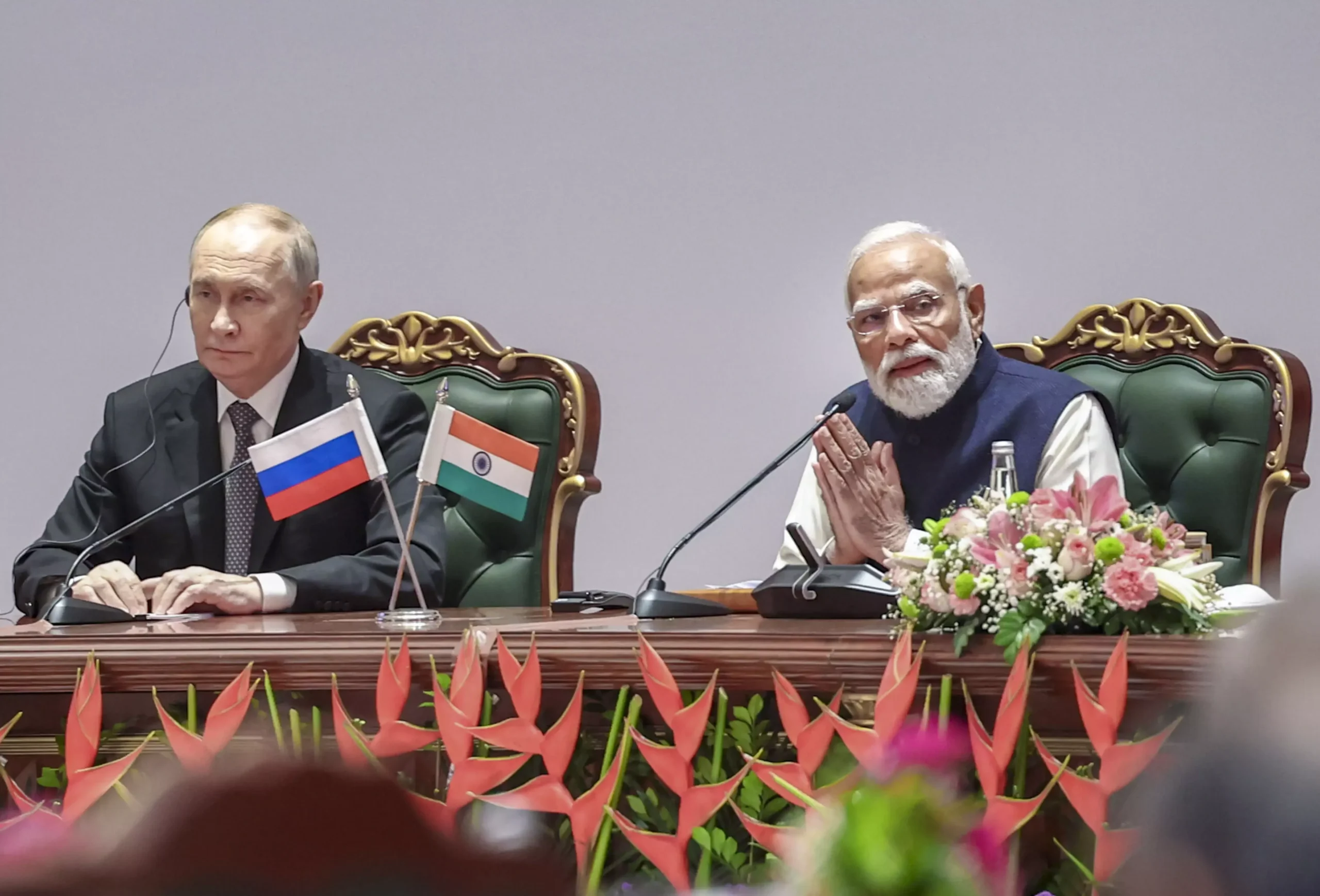
Prime Minister Narendra Modi and Russian President Vladimir Putin during the India-Russia Business Forum, in New Delhi. (narendramodi.in via PTI Photo)
PM Modi and President Putin stressed the importance of further discussions on identifying a second site in India for a Nuclear Power Plant
New Delhi: India and Russia have moved to strengthen their ‘Special and Privileged Strategic Partnership’ by expanding cooperation across key sectors including trade, nuclear energy, defence, and science and technology. The Ministry of External Affairs released a joint statement on Friday December 5, 2025 summarising the major outcomes of the 23rd India-Russia Annual Summit attended by Prime Minister Narendra Modi and Russian President Vladimir Putin.
PM Modi and President Putin stressed the importance of further discussions on identifying a second site in India for a Nuclear Power Plant (NPP). Russia also reaffirmed its commitment to making the Kudankulam Nuclear Power Plant (KKNPP) fully operational. According to the joint statement, India will work to finalise the formal allotment of the second site as per previously signed agreements.
Both leaders agreed to broaden cooperation in nuclear energy, including the fuel cycle, life cycle support for operating units at Kudankulam, and non-power applications of nuclear technology. During a joint press briefing, Putin highlighted the progress at Kudankulam, where two of the six reactors are already operational and four remain under construction. He said achieving full capacity would significantly contribute to India’s energy requirements.
The two countries also decided to craft a new agenda for collaboration in the peaceful use of atomic energy and high technologies. The joint statement emphasised the importance of nuclear cooperation in light of India’s plans to increase its nuclear energy capacity to 100 GW by 2047. Both sides agreed to accelerate discussions on Russia’s VVER reactor technology, joint development of NPPs, and localisation and joint manufacturing of nuclear equipment and fuel assemblies for large-capacity Russian-designed reactors.
On space cooperation, India and Russia welcomed enhanced collaboration between ISRO and Roscosmos, particularly in human spaceflight, satellite navigation, and planetary exploration. Progress in joint work on rocket engine development and production was also noted.
Both sides expressed satisfaction with efforts to ensure the long-term supply of fertilisers to India. A Memorandum of Understanding was signed among JSC UralChem, Rashtriya Chemicals and Fertilisers Limited, National Fertilisers Limited, and Indian Potash Limited to facilitate joint ventures in this sector.
To strengthen connectivity, an MoU on training specialists for ships operating in polar waters was signed, supporting the development of transport links such as the International North-South Transport Corridor (INSTC), the Chennai–Vladivostok Maritime Corridor, and the Northern Sea Route. The two countries also affirmed their intention to enhance trade and investment cooperation in the Russian Far East and the Arctic, with a 2024–2029 cooperation programme providing a framework for collaboration in agriculture, energy, manpower, mining, pharmaceuticals, and maritime transport.
Both sides underscored the importance of bilateral consultations on Arctic issues and welcomed progress in cooperation on the Northern Sea Route. Russia appreciated India’s participation in the 6th International Arctic Forum in Murmansk in March 2025, while India reiterated its readiness to play an active role as an Observer in the Arctic Council.
In the defence sector, India and Russia agreed to encourage joint manufacturing of spare parts, components, and equipment for Russian-origin defence systems under the Make-in-India initiative. This includes technology transfer and the establishment of joint ventures to support both Indian military requirements and exports to friendly third countries. Both leaders expressed satisfaction with regular military contacts, including meetings on the sidelines of the SCO Defence Ministers’ Meeting and the conduct of the joint INDRA military exercises.
Both countries also agreed to continue developing systems for bilateral settlements using national currencies to support uninterrupted trade. Discussions will continue on enabling interoperability between national payment systems, financial messaging platforms, and central bank digital currency systems.
Russian President Vladimir Putin concluded his two-day visit to Delhi on Friday December 5 , 2025 night.
( Source : ANI )

YOU MAY LIKE THIS